- On Nature
- I believe Nature is complex, ever-changing, and inescapable. All truth is contained in Nature. Everything that we learn, we learn by observing and interacting with Nature, the Great Teacher.
- I believe we humans are part of Nature. Everything that is is part of Nature. There is nothing that is not Nature. It is literally impossible for things to happen that are "unnatural".
- I believe there is only one family tree on Earth; all living creatures are kin.
- On Human Lives and Bodies
- I believe that every human life has inherent dignity and worth.
- I believe that our bodies are inviolable. It is grievously wrong to violate another person's bodily sovereignty.
- I believe love is a precious thing, to be sought after, delighted in, and celebrated in all its multi-mysterious forms.
- It is best for the strong to care for the weak, as best as we are able.
- On the Spirits
- I believe that humans share our world with a large variety of sentient beings, both embodied and otherwise.
- I believe that we owe the same duties of compassion, community and care to unembodied sentient people as we do to those with bodies.
- I believe that worship is owed to no being, but can be freely given, and accepted, in love and communion.
- On Community
- I believe it is best to always strive to act with compassion towards all beings, to the best of our ability, and in accord with reason.
- I believe people are fallible. We have all made mistakes. We all will make more. When you know you have done wrong, you should strive to set right what you broke.
- I believe humans are meant to live in community with own another, sharing our loves, lives, property, and efforts with one another, working towards a common good.
- On Economics
- I believe the notion that one human being can compel the labor of another is absurd and grievously wrong. And yet, we live in a world where few of us can avoid it. We must use our best judgements about how and when and where it is best to buy and sell labor in an honest and ethical manner.
- I believe that the very notion that a human being can own land is absurd and grievously wrong. And yet, we live in a world where few of us can avoid it. We must use our best judgements about how and when and where it is best to buy, sell, safeguard, and steward land in an honest and ethical manner.
- I believe that a person cannot be fully spiritually free while they are materially in debt. Debt, capitalization of debt, and the culture of debt are among the great moral dilemmas of our time. And yet, we live in a world where few of us can avoid it. We must use our best judgements about how and when and where it is best to borrow and lend in an honest and ethical manner.
Saturday, June 1, 2019
Pagan Ethics
Following in the footsteps of my teachers, friends, and elders like Ian Corrigan and John Becket, I thought I'd talk a little bit about Pagan Ethics, as I see and practice them. This is a post about what I believe is right, and why I believe it is right. I'd very much like to hear yours. If you would like to discuss this topic with me and my circle, there is a gathering to do so Sunday June 3rd at Witch House from 2-6pm.

Tuesday, March 26, 2019
Chains of Silence
In the course of my work, I often run across the same kinds of curses, bindings, and soul-injury across several people. Today, I'd like to tell you about one I call the "chains of silence" which I most often see in older (55+) women. (however, that demographic is over-represented in my clientele) To me, this affliction appears as a chains, sometimes barbed wire, wound around the person's throat. It is sometimes accompanied by thyroid problems (about 40% of the time, IME) or other throat or neck issues. I am reasonably confident that it is related to being silenced as a child, most often, being silenced after a trauma. I will first describe how I diagnose and treat it in someone else, and then how you might treat it at home, if you suspect you may have this issue. I have never done this work on myself, but I would imagine it is harder on yourself than someone else (as most curse breaking is).
How to Diagnose:
Enter into the Other Place in your usual fashion, and contact an ally you work with for diagnosis Asklepios is excellent for this work, although I usually work with Merlin instead, who has given me a sort of tricorder/dowsing-rod when we do this work. You might ask for a similar diagnostic tool. It is extremely important to work with a trusted long-term ally for this, and to do a lot of grounding first, to be sure that you're not projecting your own issues onto other people.
Examine the soul-body. (While not relevant to this particular affliction, be sure to check the feet and ankles. I often find bindings there.) To me, this affliction presents as chains or barbed wire wound around the neck, but I do not know if it will appear that way to you or not. Examine the area. Most often, the chains have grown into the flesh in a very unwholesome way, like they would into a tree. Sometimes, they can be almost completely covered in skin.
 |
| deviantart.com/tahnja/art/Our-Lady-of-Sorrows-184163446 |
How to Ameliorate:
When everyone is ready, return to the Other Place and ask Mary (or whoever) to cry on the chains. This will transform them into rose vines (with thorns). These can very slowly and carefully be unwound. Try not to tear the surrounding area, but some tearing is inevitable if they are really overgrown. You might not be able to unwind all of it in one session. When you and/or the patient have had enough, use a magical knife to cut the vines. Take the part that you have removed to a disposal location, such as a naga pool or volcano or abyss. DO NOT leave it lying around, because it can slither like a snake and re-attach (or attach to you).
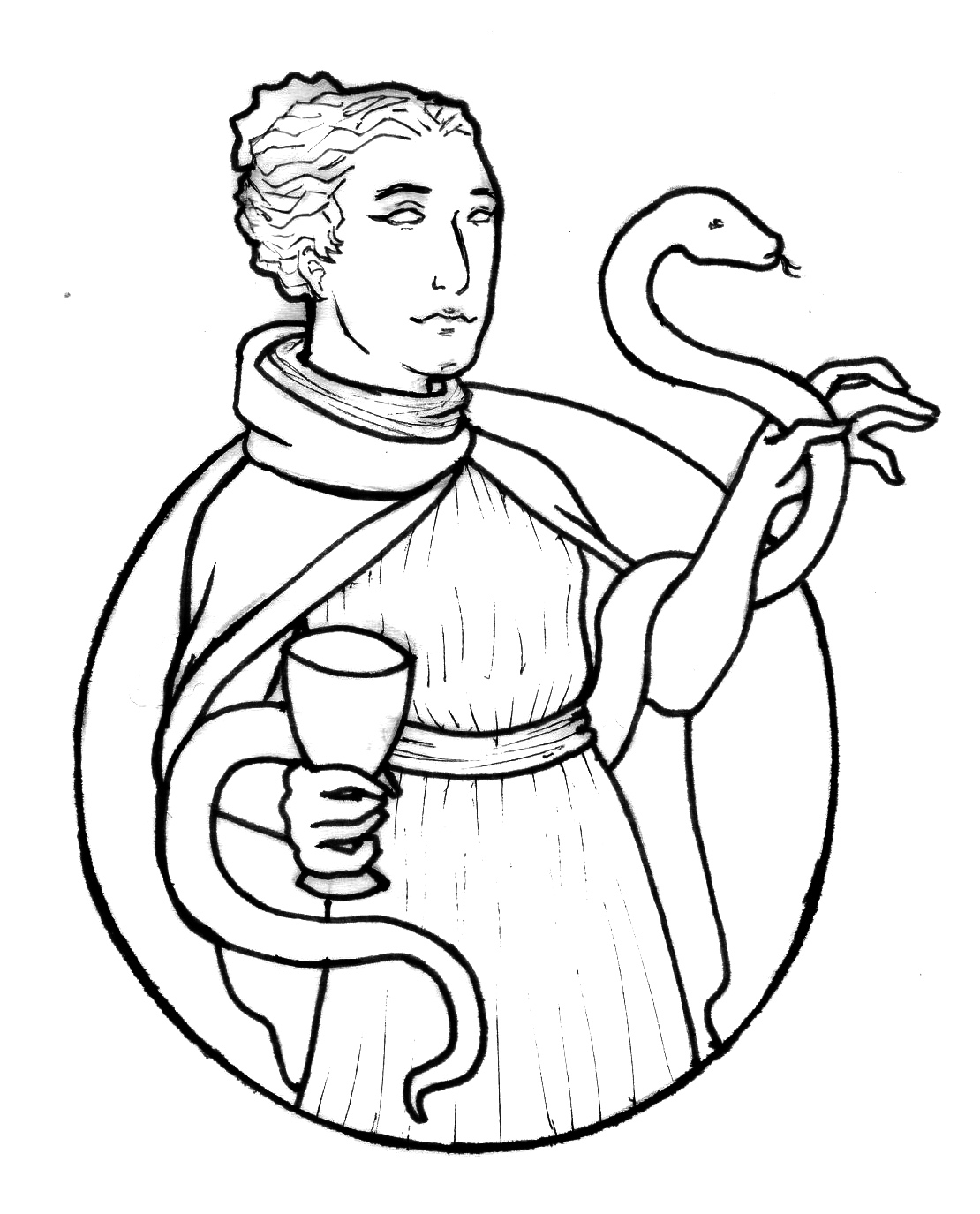 Return to the patient, and call Hygeia (or another healing deity who carries a cup). Have her wash the wounds from her healing cup, and then apply solar energy (mine is in salve form) to promote healing. Often times, the patient's power animal will appear and lick the wounds clean. Bandage the wound with clean white dressings. Sometimes, Theotokos offers her veil for this purpose.
If necessary, repeat the procedure at a later date, but allow time for healing in between. (I would say at least a month). Tell the client that they might expect some dreams related to this, but to report if there are repeating nightmares, or if they develop a sore-throat or any other throat symptoms.
How to Cure in Yourself:
If you have experience with the sort of work outlined above, I think you could use a very similar procedure on yourself. You may wish to call all the allies at the beginning, and instruct them all before beginning. However if you do not feel you are up to that, then I think you can probably do this:
Orphic Hymn to Hygeia
Ever-blossoming Queen of All,
Many-blessed All-Mother, Hygeia, I call.
You banish all injury, affliction, and illness
And cause every home to blossom in bliss.
Every craft lusts after your ordering hands,
Reaching out, ever gentle, you plumb the dry lands,
Saving those souls that Hades would destroy,
And filling up every house with the fullness of joy.
You’re hated by Hades, who plunders the souls of the living.
Eternally thriving, your prayers are life-giving,
Without your your holy magic, your guiding spells,
Humans lives drift, bobbing like corks on the swells,
In the absence of you, Plouton’s gifts lose their sweetness,
And human old age brings only hardship and weakness.
For you alone hold such power over peasant and king.
Multi-mysterious Goddess, your praises we sing,
Defend us from sickness and all leaden pain,
Let us bask in your light and rejoice in your reign.
Wednesday, March 6, 2019
Threshold Protections (Witch House excerpt)
I'm sorry I havn't been posting much. The Orphic Hymns Grimoire is in its final stage of editing, and that has basically consumed my whole life. But, I thought I'd give you a sneak peak of my next book, which is a beginners' book on enchanting your house. This is from Chapter Three:
Protections for the Threshold:
An Excerpt from Witch House: Enchantment Room by Room

In Greece, belief in the evil eye is very old; the classic blue eye design appears frequently on ancient pottery. In addition to the use of glass talismans to ward off the evil eye, a form of exorcism called “ξεμάτιασμα” can be performed to “cure” the affliction. While the Orthodox Church has a prayer for this use, it is more common for each family to have it’s own prayer, a closely guarded secret handed down from grandfather to granddaughter, and from grandmother to grandson. I cannot teach you my family’s prayer, but here are two I’ve written to inspire you to write your own, and start your own family tradition:
Holy Virgin, Queen of Heaven,
Mother of God, Mother of All,
take us under your sky-blue cloak,
and protect us from all evil.
Avert, avert, avert!
or
Thea Euryphaessa, Queen of Heaven,
Holy Wide Shining One,
Mother of the Dawn, and the Moon,
and the ever unconquered Sun,
Yours is the eternal Aithre; yours the clear blue sky,
Yours is the vision of prophecy, yours the all-seeing eye.
Shine your light upon this home,
And send all evil away to roam!
Avert, avert, avert!
I like to hang a large nazar talisman where it can glitter in the sun. Because my front door is shaded by the porch roof, mine hangs instead in my front window.
The blue eyes of the nazar are often found at the center of another type of amulet, one shaped like an open hand, made symmetric with outward curving pinkie finger and thumb. These amulets are called “hamsa” in Hebrew and khamsa in Arabic; both words mean “five” and refer also to the hand. Although they certainly predate Islam and Christianity, and likely also predate Judaism, they are also sometimes referred to by more religious people as the “Hand of Miriam” (Moses’s sister), “Hand of Mary” (Jesus’s mother) or “Hand of Fatima” (Mohammed’s wife). To me, these names strongly indicate that the talisman is associated with the Great Goddess, who is sister and mother and lover of us all. This is bolstered by the fact that similar open-hand designs occur on ancient ritual objects sacred to Ishtar, Inanna, and Tanit, respectively Babylonian, Sumerian, and Carthaginian names for Her.
In ancient Carthage, as well as in Jewish, Arab, and Berber houses around the world, a handprint is often painted on a door; usually in white on red doors or red on a white door. Instead of painting onto the door, however, most times the hand is hung as a metal ornament upon the door, either inside or out. Such amulets are nearly ubiquitous in Middle Eastern stores, with inexpensive versions made in steel and pot metal, and fancier version in sterling silver or cobalt glass. Small bells are often attached to the ends of the fingers. Unlike the handprints, which usually occur fingers up, metal hamsa are usually hung with the fingers pointing down.
Mother of the Dawn, and the Moon,
and the ever unconquered Sun,
Yours is the eternal Aithre; yours the clear blue sky,
Yours is the vision of prophecy, yours the all-seeing eye.
Shine your light upon this home,
And send all evil away to roam!
Avert, avert, avert!
I like to hang a large nazar talisman where it can glitter in the sun. Because my front door is shaded by the porch roof, mine hangs instead in my front window.
The Amulet of the Open Hand
The blue eyes of the nazar are often found at the center of another type of amulet, one shaped like an open hand, made symmetric with outward curving pinkie finger and thumb. These amulets are called “hamsa” in Hebrew and khamsa in Arabic; both words mean “five” and refer also to the hand. Although they certainly predate Islam and Christianity, and likely also predate Judaism, they are also sometimes referred to by more religious people as the “Hand of Miriam” (Moses’s sister), “Hand of Mary” (Jesus’s mother) or “Hand of Fatima” (Mohammed’s wife). To me, these names strongly indicate that the talisman is associated with the Great Goddess, who is sister and mother and lover of us all. This is bolstered by the fact that similar open-hand designs occur on ancient ritual objects sacred to Ishtar, Inanna, and Tanit, respectively Babylonian, Sumerian, and Carthaginian names for Her.
In ancient Carthage, as well as in Jewish, Arab, and Berber houses around the world, a handprint is often painted on a door; usually in white on red doors or red on a white door. Instead of painting onto the door, however, most times the hand is hung as a metal ornament upon the door, either inside or out. Such amulets are nearly ubiquitous in Middle Eastern stores, with inexpensive versions made in steel and pot metal, and fancier version in sterling silver or cobalt glass. Small bells are often attached to the ends of the fingers. Unlike the handprints, which usually occur fingers up, metal hamsa are usually hung with the fingers pointing down.
Monday, December 24, 2018
How to Craft a Spell

This is the general process I go through when creating and then working a spell. Hopefully, it will be helpful to you in learning to craft your own spells. This teaching is based on George Polya's famous book "How to Solve It" which I cannot recommend highly enough. If you google for it, you can probably find the full text online. There's a summary of the book on page eight on the book.
I can provide additional instruction or support (or just do it for you) any of these steps for $150 per hour. Email me at Sara@MastrosZealot.com to arrange a session.
How to Make a Spell
Step One: Understand the problem. Be careful what you wish for.
What is the current situation?
Carefully examine the situation from your current point of view. Write a full page, in complete sentences, describing the situation you would like to witch. It can help to ask yourself the following questions. You may wish to use (or purchase) some divination (such as a tarot reading) to help you answer all these questions. I find that most situations take about an hour of investigation.- Who is involved?
- Where is the situation physically located in space?
- Make a timeline of the situation up to the present moment.
- How do I feel about the situation, emotionally? How do others feel about it? Here is a list of emotions to help you think about it.
- How is this situation operating? What is sustaining it?
- How will the current pattern play out over time if uninterrupted?
- Why is this situation happening? What was the original cause?
- Who benefits from the current situation? What forces in the world work to keep this status quo?
- Can you represent the problem with a picture?
- What information do you already know?
- What similar situations have I done in the past? How did they play out?
What would you like to be different?
Write a full page description of the situation as you would like it to be. Ask yourself all the same questions you asked before. It's ok if you don't know all the answers. Be as specific as you can about the situation, but try to avoid describing the path from here to there. Be sure to think about who and what, other than you, would benefit from the situation being as you wish it. Be sure think about the timing; WHEN do you want these changes to happen? Be specific. The longer you can wait, the easier it will probably be, but fix a deadline. As a rule of thumb, most beginner spells should be showing some kind of results (although might not be fully complete) in a month or less. If your deadline is more than a month away, consider cleaving off some shorter-term goals. Here are some questions to ask yourself:- Can I describe the desired change in a single sentence?
- What similar changes have I been able to make in the past?
- Can I break this problem into several smaller, more manageable problems?
- What is a simpler version of this problem which I already know how to solve?
- Who do I know who has solved this problem before? How did they do it?
- Start with the goal and work backwards; what does it look like as it unfolds?
Step Two: Make a Plan/Recipe
In most situations, this is the most difficult step. It is best learned from a teacher (human or other) but you can teach yourself by carefully examining a lot of spells that were crafted by experts and trying to figure out why they did it the way they did. Work some of them as written, and adapt/recombine others. Once you have more facility in spell craft, you can skip this step and invent as you go (just like an experienced chef might make up a dish as they cook it). BUT, that skill is born from having a lot of experience, and a huge library of "recipes" in your head already. If you're going to hire a witch to do anything, this is the step you should pay for; in most circumstances, I can write a custom spell for almost any situation in about 2 hours. The easiest/cheapest thing is to finding a ready-made "off the rack" spell and then adapting it to your own needs. Some "spell recipe books" (sometimes called "grimorium") that I like are:
- The Orphic Hymns
- The Greek Magical Papyri are a collection of spells from the syncretic Grekophone culture of the eastern Mediterranean in late antiquity, collected mostly in Egypt. These require some level of familiarity with that culture.
- Ancient Jewish Magic, by Gideon Bohak. Requires some familiarity with that culture.
- The Fourth Book of Abramelin the Mage is a 14th century Ashkenaz (German Jewish) grimoire. Like the PGM, it requires familiarity with that culture. (some of which is provided in the Dehn/Guth edition)
- Book One of Key of Solomon is an 15th century upper-class European Christian grimoire, and requires familiarity with that culture.
- Pow Wows: The Long Lost Friend is a 19th century PA Deitsch grimoire, and requires some familiarity with that culture.
- Mastering Witchcraft, Paul Huson
- Hands on Chaos Magic, by Andrieh Vitimus
- Protection & Reversal Magic, by Jason Miller. Financial Magic, by Jason Miller. are useful for beginner magicians in those particular areas.
- Encyclopedia of 5000 Spells, by Judika Illes
- Cat Yronwode's Lucky Mojo site.
- How will I target the people and things involved in the current situation? You need to forge a path that links you and your spell to the targeted situation.
- The easiest links to people are full names, photos, videos, or audio recordings. Pieces of their body (such as blood, semen, hair, etc) are excellent. Generally, you don't need links to yourself, because your you-ness is that link, but if you want to work on a specific part (physical or otherwise) of you, how can you represent that?
- The easiest links to places are google maps surveillance and pieces of the place (like dirt or pebbles.
- For corporations, logos, names, photos/recordings of important people, and place-links to offices are all good. Branded merchandise, like letterhead, pens, and magnets are also excellent.
- Bank account statements and wallets are good links for cash-drawing magic.
- How will I link to the desired outcome?
- Draw a picture of it.
- Can I make/manipulate a physical object to represent it? (such as a poppet)
- Describe it in a single word, or a very short sentence.
- Make a sigil from that sentence.
- What other symbols can I sue to represent it?
- How can I manipulate the first set of links into the second?
- For example, to seduce a person, you might make a link to them and then rub honey on its lips and rose oil its genitals.
- For example, to get more money, you might put monopoly money in your wallet.
- Who can I recruit to help?
- What humans have the power to change this situation?
- How can I recruit them to my team? Some things to consider trying:
- Ask nicely?
- Offer to trade favors
- Buy them off
- Seduce them
- Make friends with them
- Trick them (often unwise)
- Threaten or compel them (often unwise)
- Are there other human magicians I can recruit to my cause?
- Friends of friends? Other networked folk?
- What agentic/sentient forces in the world would benefit from the situation being the way I want it to be?
- Are the spirits that love me (ancestors, personal gods, spirit guides, etc) on board? If not, consider the idea that they might be right before proceeding. They might not be, but if the collective wisdom of everyone who loves you thinks this is a bad idea, they're probably right.
- Is this good for my Community (however you define that)? Work with communal totem-spirits. If it's bad for you community, you might once again want to stop and consider if it is a wise action.
- Is this good for the Land? Work with local land-spirits, and with Gaia herself. If it's bad for the Land, you might once again want to stop and consider if it is a wise action.
- Are their gods who might help? Who wants to see this done? For example, Hera likes to make good marriages. Hephaestus likes to help people get good jobs that pay an honest living for an honest days' work. Ishtar wants to help you have amazing sex with enthusiastic partners. Pluton wants you to be rich as fuck. Hygeia wants you to flourish with health. etc, etc. If no gods wants to help with this, is it unwise?
- Are there plants, animals, ghosts, demons, or other kinds of sentient creatures that I can recruit to my cause? What will it cost to convince them?
- Are there medicines or other chemical spirits that want to help? These are especially good for healing work.
- What materia and symbols are related to this situation?
- colors?
- incense?
- music or chants?
- herbs?
- stones?
- magic words/names?
- sigils and seals?
- costumes?
- What will power the spell? Generally, it's best to combine multiple sources for anything big. Remember, this energy can be stored, either in your own body for short-term use, or in constructed amulets/talismans/potions etc for longer-term storage, but most of it will probably need to be channelled thru your body in some way, because your body is your only mechanism of interface between the physical and non-physical worlds. Non-physical magic yields non-physical results.
- Your own personal chi/prana/body-spirit-power. You can build more of this in your body in the short-tem with any of the following techniques:
- breathe deeply and powerfully of fresh, clean air
- drink water
- eat wholesome food
- dance about, or otherwise move to aerate your body
- hum/sing/drum or otherwise make noise
- some kinds of drugs
- sex (alone or with partners)
- There are also many long-acting techniques to build your capacity for personal power, including prayer, meditation, qi gong and pranayama.
- Other people's chi/prana/body-spirit power
- Most humans radiate small amounts of chi most of the time. Places thick with humans, especially humans engaged in high energy enjoyable activities, are thick with power.
- Churches, nightclubs, gyms, and playgrounds are all excellent power sources. Personally, outdoor raves are my favorite.
- So are hospitals and prisons but that's kind of a shitty place to get your energy, because the people there need it more than you do.
- Personally, the single most energetically potent thing I have ever done is chaperone a high school dance, cock-blocking a couple hundred teenagers in heat.
- Remember, if you're going to such a place, bring a talisman or other kind of "battery' to charge for later.
- Other living creature's chi/prana/body-spirit-power.
- Forests and other naturally balanced life-dense locations are excellent for this.
- Factory farms and slaughter-houses are powerful, but also terrible.
- Other non-physical spirits will provide the power
- Fire, light, sun, moon, or other luminous/radiant energy sources.
- Power stored in an object, such as talismans, machines, or cash.
- Power of a place (such as a river or temple)
- Power of a time (astrology is good for finding these)
- How will you get the power from the source into the spell?
- Mediate it thru your body by:
- physically consume it
- sense-perceive it (for pictures, sounds, etc)
- speak its name aloud
- write or draw it
- moving stuff around
- Physically attach it to the links
- Think/feel about it real hard (not super effective, but it does work)
Step Three: Enact Your Plan
Most plans will involve most of the following steps in more or less this order:
- Clean the space you'll be working in. It should be clean, healthy, and in good balance on both physical and spiritual levels. How long this takes mostly depends on how long it's been since you last cleaned. DO NOT over-clean, banish, or "sanitize" unless you have reason to believe there is something unwholesome or counterproductive to the work in the environment. Healthy natural environments are mostly self-cleaning; pick up any human litter or etc, and you're good to go.
- Collect links, materials, and tools and arrange them in a convenient and aesthetically pleasing fashion. Personally, I like to construct a little altar, with an ikon of spirits who will be helping, pre-written hymns or chants, materials in pretty bowls, and etc. My working table is painted with whiteboard paint, so I can draw/write directly on it. If you are more physical in your magic, and will move around a lot, you might want to make a magical costume for yourself that has a lot of pockets or arrange the material in the ground in a circle around your working space. If possible, set up somewhere you can leave things set up until the spell has worked. Trays, which can be worked on a table and then moved somewhere out of the way, are helpful for this.
- Clean yourself. Use the restroom to eliminate internal waste. For bigger workings, take a shower or bath, but for small stuff, it suffices to wash your hands and face. Focus on washing away impure (ie irrelevant to the work at hand) thoughts and feelings while you use the restroom and wash.
- Set the "vibe" in your space with incense, lighting, music, etc.
- Set a timer so you know when to begin and end (I like to use this free online sound machine for this, because they also help to "set the vibe".
- Enter into magical consciousness (trance). For a new magician or lay person, this can take up to an hour. With practice, you will get much, much faster at this. Most expert magicians should be able to do it in less than 3 minutes. Until you are so tranced out that you can't follow your plan, you can't really over do this. There are many, many methods for this including
- oration / chanting (my favorite)
- singing / music making
- drawing/writing
- moving (dance or etc)
- spinning or other handcraft
- meditation
- breathwork
- drums or other rhythm
- entheogens
- Preform the spell.
- Exit magical consciousness and recharge the spent power. Just like it can take a long time for inexperienced magicians to enter, you might need some time to recover. Drink some water. Wash your hands and face. Eat something. Take a nap, etc. Once you get better, this will be easier and faster. If you worked with unwholesome power sources or spirits, clean yourself. (but this is not recommended for beginners)
- Clean up the space if needed.
- Don't obsess over it. It's done. Just let it work. If you find yourself obsessing, try reciting a relevant hymn or chant (even in your mind) to help empower the work when your mind turns to it, but, as much as possible, do not attach to your desires. If you often find yourself unable to let thoughts go, learn to meditate. If obsessive thoughts and compulsive desires are interfering with your life, seek professional help.
- If there are mundane actions you can take to help the work along, do those things.
Step Four: Analyse & Improve
- After a suitable period of time (most beginner spells should see some results in a month or less) look back over what you've done and decide if it worked.
- If your got just what you asked for:
- How long did it take?
- What path did it take?
- Using hindsight, how might you have made the spell more efficient if you had known the path in advance?
- What other situations could you adapt this spell to?
- Did it improve the situation, even if it didn't fully work?
- What is preventing it from fully manifesting?
- Is there sufficient power, or should you add more?
- Now that you can see the path it's taking, can you grease the rails in any way? (by mundane action or magical effort)
- Are there blocks you can remove? (by mundane action or magical effort)
- Is it a complete failure?
- Are there blocks you can remove?
- Does it need more power?
- Does it need better links?
- Were you sufficiently entranced?
- Was your spell poorly written? Try a different one.
- Did it make things worse?
- AS SOON as things get worse, unless you can see a clear path from where you are now to your goal, dismantle the spell and start over.
- Try to figure out why you went wrong. Usually, this is caused by a poor understanding of the actual problem. Be careful what you wish for.
If you'd like to learn more, please check out my course Introduction to Witchcraft: Thirteen Lessons in Practical Magic. The first lesson is free.
Wednesday, November 14, 2018
Educational Funding Policy
Proposals for Changes in Educational Funding

Intro: What is the shape of the current market for education in the US?
In the current 2018-2019 school year:
- There are about 57 million school-age children in the US, who are the consumers.
- There are about 3.6 million teachers, who are the producers.
- Total spending on K-12 ed is about $650 billion (about $13K per student).
- About 3.6 million kids graduate from high school each year, 92% from public schools.
In general, the government has four tools to intervene in a market, including the market for education:
- Purchasing power: For example, negotiating prices for prescription medications purchased by Medicare. Many agricultural and other commodity subsidies are implemented this way, with the gvt buying up "excess" production to artificially inflate prices.Single-payer systems (such as "Medicare for all") are an extreme case of this where the gvt is the ONLY purchaser (this called a "public monopsony"). There are not many public monopsony markets in the US. You would think that military systems SHOULD be an example of this, but US companies sold more than $56 billion dollars of weapons of war to purchasers other than the US gvt (both private mercenaries like Blackwater and foreign governments).
- Taxes: Taxing "bad" stuff and subsidizing "good" stuff with rebates or deductions.
- Regulation: Restricting the sale of "bad" stuff and requiring the purchase of "good" stuff. For example, we regulate the sale of tobacco and require the purchase of health insurance.
- Public Provision: Some stuff, the government is the sole (or majority) provider of. For example: national defense, emergency services, infrastructure, and education are all primarily, but not exclusively, publicly owned. (that is, to say, the means of production are public)
All of these mechanisms are at play in education. Going backwards up the list:
4) About 90% of current K-12 students are in public schools. Of people currently enrolled in post-secondary education, about 3/4 are in public colleges. These percentages have been roughly stable over the last several generations. Of private K-12 education, 36% of students are in Catholic schools, another 39% in other religious schools, and 24% are in secular schools. About 3% of school-age children are not enrolled in school (most of these are home schooled). Another way to say this: Of 1000 kids ages 6-18, roughly 900 go to public school, 53 go to religious schools, 17 go to non-religious private schools (mostly fancy prep schools), and 30 are not in school at all.
3) Private education is very regulated, although regulations vary greatly between states. PA is among the more restrictive states.
2) This is the least used tool in K-12 education policy. Many people think private K-12 tuition is subsidized or tax deductible, but largely it is not. OTOH, tax subsidies are very much in play for preK and post-secondary education.
1) Publically funded grants and scholarships, such as private school vouchers or Pell grants are examples of this.
I don't feel like we need to either incentivize or discourage private vs public school decisions. I think that arguments about whether or not we should funnel money "away" from public schools and "to" private ones, and also arguments that families should be able to choose "the school that's best from them" are distractions from the more relevant point that everyone is entitled to the best education we can give them, and decisions about what kinds of education are best are better handled by licensing than tax policy. In what follows I'm going to talk about how to fund the 90% of K-12 and 75% of post-secondary education that is publicly produced. I don't know much about preK education, so I'm not really going to talk about that at all.
What do we spend on public education?
1) Publically funded grants and scholarships, such as private school vouchers or Pell grants are examples of this.
I don't feel like we need to either incentivize or discourage private vs public school decisions. I think that arguments about whether or not we should funnel money "away" from public schools and "to" private ones, and also arguments that families should be able to choose "the school that's best from them" are distractions from the more relevant point that everyone is entitled to the best education we can give them, and decisions about what kinds of education are best are better handled by licensing than tax policy. In what follows I'm going to talk about how to fund the 90% of K-12 and 75% of post-secondary education that is publicly produced. I don't know much about preK education, so I'm not really going to talk about that at all.
What do we spend on public education?
In total, the US spends about $640billion on K-12 education, but only $24 billion of that is federal. Nearly all educational spending (about 80%) goes to labor costs, of which nearly 60% is spent on teacher salaries. Teaching is not currently very automatable, and there is nearly overwhelming evidence that says less students per teacher is better, almost no matter what. For this reason, we cannot substantially decrease the amount of labor needed. Since we have a growing national teacher shortage, which in some fields (including secondary math and science) is reaching crisis levels, in the absence of radical reforms in teacher training, recruitment, and retention (which I will talk about some below) or dramatic changes in retirement, health care, and other benefits, we should expect per teacher labor costs to continue to rise. That means that education costs should be expected to continue rising for the foreseeable future at substantially greater than inflation rates.
The national median per-pupil expenditure per student for public K-12 education is about $11,750 per year, but this caries VERY dramatically state to state and school district to school district, from a low of $7000 in Utah to a high of about $22,400 in New York. Within each state, this also varies excessively among districts. PA spends about $15K. Some examples from the greater Pittsburgh region: City of Pittsburgh: $23K. Woodland Hills (my local district):$17K. Upper St. Claire (a rich white district): $18K. Differences in spending do not strongly correlate with differences in performance, until you control for the demography. MOST DIFFERENCES IN PER PUPIL EXPENDITURE ARE BECAUSE SCHOOLS ARE FORCED TO OPERATE OUTSIDE THEIR SCOPE OF PRACTICE TO PROVIDE STOP GAP BACKUP FOR SHITTY SOCIAL WELFARE PROGRAMS. It is much, much cheaper to educate students who are homed, safe, healthy, and well-fed, than it is to educate kids who need more substantive extra-educational support. Policies on how to make a dent in this problem below. (We cannot fantasize that changes in school tax policy are enough to address our nation's shameful childhood poverty problem. I'll talk about some ways I think education CAN address the problem below.)
The overwhelming majority of educational funding happens at the local level. In almost all places, including here in Pennsylvania, schools are funded almost entirely via property taxes. This has the effect of ghettoizing schools. HOWEVER, the federal government has many mechanisms by which it can help fund schools more equitably.
My proposals below are all more or less revenue neutral:
The overwhelming majority of educational funding happens at the local level. In almost all places, including here in Pennsylvania, schools are funded almost entirely via property taxes. This has the effect of ghettoizing schools. HOWEVER, the federal government has many mechanisms by which it can help fund schools more equitably.
My proposals below are all more or less revenue neutral:
Expanding the net investment income tax to income earned in S corps and lmt partnerships. This affects only those who earn more than $200K per year from investments. That should raise about $13 billion in the first year after implementation. With that $13 billion, I would spend:
approx $3 billion on teacher housing subsidy grants. These grants would be ONLY for teachers who live in the same neighborhoods as the students they teach, and would focus on low-income neighborhoods. That is, the less money the average student has, the more money the school has to spend on housing grants. It's hard to calculate how much this would cost, because I can't get reliable data on how many teachers live in their catchment area, and I do not know how to predict how much this would change those numbers. This would help to "level the playing field" by making low-income schools more competitive in attracting quality teachers, and also allows them to hire more of them. It also encourages schools to be run by the people they serve, and strengthens community investment in the school. When teachers live in the same communities as their students, they are better able to directly address those student's needs. Additionally, it strongly incentivizes people in low income neighborhoods to consider teaching as a career.
$10 billion to hire about 150,000 new social workers and medical professionals in low-income schools. I would weight this aid toward the lowest income schools. I'd like about 1 new person for every 125-500 low income students (depending on how weighted it is). I don't have more specific policy on this, but would be interested in talking about it. I would like the social workers and nurses to be eligible for the same housing subsidies I proposed above.
Implement a financial transaction tax similar to the DeFazio-Harkin. This would barely impact anyone except extremely wealthy financial speculators, and would raise $50billion, which I would spend to hire 300,000 new teachers of Civics, Economics, Statistics, and Entrepreneurship, again weighted toward low-income schools. That's one teacher for every 15 students; ie enough to give EVERY student in the country a teacher in those fields every year.
Impose a new progressive estate tax, starting with 1% at estates over 1 million and scaling up to 35% for estates over 5 million and capped at 60% for estates over 10 million. This would raise about 50 billion per year.
I would spend that on before and after school child care, mentoring and enrichment programs in foreign languages, sports and fitness, arts, crafts and trades, music, computers, nutrition & cooking, gardening, and other recreation in low income schools. This is give every low income student in the US an after-school mentor. (assuming those mentors cost about $45K per 20 students) . Since, presumably, not all families will choose to enroll their students in these programs (I can imagine a lot of churches will run their own competing programs, for example) there should be enough.
Expand the National School Lunch Program (which feeds about 30 million kids for about 13 billion dollars, which is about $2.40 per meal) to also include breakfast. Fund this with a 1.5 cents per ounce tax on sweetened beverages. (similar to the Philadelphia soda tax). Assuming that the average American drinks only half as much soda as the average Philadelphian, this would raise about 9 billion dollars or $1.60 per meal for 30 million kids.
approx $3 billion on teacher housing subsidy grants. These grants would be ONLY for teachers who live in the same neighborhoods as the students they teach, and would focus on low-income neighborhoods. That is, the less money the average student has, the more money the school has to spend on housing grants. It's hard to calculate how much this would cost, because I can't get reliable data on how many teachers live in their catchment area, and I do not know how to predict how much this would change those numbers. This would help to "level the playing field" by making low-income schools more competitive in attracting quality teachers, and also allows them to hire more of them. It also encourages schools to be run by the people they serve, and strengthens community investment in the school. When teachers live in the same communities as their students, they are better able to directly address those student's needs. Additionally, it strongly incentivizes people in low income neighborhoods to consider teaching as a career.
$10 billion to hire about 150,000 new social workers and medical professionals in low-income schools. I would weight this aid toward the lowest income schools. I'd like about 1 new person for every 125-500 low income students (depending on how weighted it is). I don't have more specific policy on this, but would be interested in talking about it. I would like the social workers and nurses to be eligible for the same housing subsidies I proposed above.
Implement a financial transaction tax similar to the DeFazio-Harkin. This would barely impact anyone except extremely wealthy financial speculators, and would raise $50billion, which I would spend to hire 300,000 new teachers of Civics, Economics, Statistics, and Entrepreneurship, again weighted toward low-income schools. That's one teacher for every 15 students; ie enough to give EVERY student in the country a teacher in those fields every year.
Impose a new progressive estate tax, starting with 1% at estates over 1 million and scaling up to 35% for estates over 5 million and capped at 60% for estates over 10 million. This would raise about 50 billion per year.
I would spend that on before and after school child care, mentoring and enrichment programs in foreign languages, sports and fitness, arts, crafts and trades, music, computers, nutrition & cooking, gardening, and other recreation in low income schools. This is give every low income student in the US an after-school mentor. (assuming those mentors cost about $45K per 20 students) . Since, presumably, not all families will choose to enroll their students in these programs (I can imagine a lot of churches will run their own competing programs, for example) there should be enough.
Expand the National School Lunch Program (which feeds about 30 million kids for about 13 billion dollars, which is about $2.40 per meal) to also include breakfast. Fund this with a 1.5 cents per ounce tax on sweetened beverages. (similar to the Philadelphia soda tax). Assuming that the average American drinks only half as much soda as the average Philadelphian, this would raise about 9 billion dollars or $1.60 per meal for 30 million kids.
My fantasy capital gains tax
My Proposed Capital Gains Tax Policy

What are capital gains, and why do we tax them differently from other income?
Skip this section if you can already formulate a coherent answer to that question. "Capital gains", roughly, are profits made from the appreciation (increase in value) of an investment. These gains are realized when you sell the asset. The archetypal example is real estate. If you buy a piece of real estate for $100,000 and then sell it 10 years later for $180,000 (which is about 6% appreciation per year; VERY reasonable for urban real estate), you have made a capital gain of $80,000. (NOTE: As I will discuss below, there are special rules for primary residence homes). It would be problematic to tax that at the same rate as income, among other reasons because the "gain" involved occured over 10 years, but the income all happened at once. Also, because there wasn't significant labor involved in the profit. To tax capital gains at the level of normal income would STRONGLY disincentivize long-term investment, which is a recipe for disaster that would rapidly concentrate wealth, property, and especially the means of production in very few hands, and encourage such ownership to be largely hereditary. (which is the direction the current policies push us toward, IMO)
When our capital gains policy was invented, almost all capital gains investments were infrastructure (the is "means of production") that the government had a clear interest in subsidizing, things like people buying homes and businesses buying new machines for their factories. However, over the last century, it has become the case that most capital gains are on much more abstract things like stocks, mutual funds, and other securities. To my mind, this clouds the waters as to whether or not we actually want to subsidize all capital investments at the same level. (you'll see below some policies to address this)
To greatly over simplify, capital gains tax policy is about balancing two opposing forces:
High capital gains taxes slow growth.
Low capital gains taxes concentrate wealth.
How do we currently tax capital gains?
Again, if you already know, skip this section. Right now, the US tax code splits capital gains into two categories: short term (investments held for one year or less) and long-term. short term capital gains are currently taxed (more or less) as normal income. Long term capital gains are (broadly) taxed as follows: If, as a single person, you make less than about $38K in total income, they are not taxed at all. Most taxpayers pay 15%. Single people with an income over about $425K pay 20%. These rates have dropped very significantly in the last 20 years. In 1997, the top rate was 28%, and the lowest 15%. Obamacare is largely financed by an additional tax on capital gains: People who make more than $200K per year pay an extra 3.8% on the lesser of (capital gains + dividends) or (earned income).
There are many weird details: Under most circumstances, the first $250,000 per person profit from the sale of a primary residence are not taxed at all. "Collectible" or "luxury" assets like coins, precious metals, art, and etc are taxed at a higher rate (around 28%). There are lots of other details to this, particularly in how the brackets work for married couples. Google can provide WAY more details if you want.
What's the problem with our current system?
Many people, particularly republicans, like to argue that higher capital gains taxes slow economic growth. The data does not support that claim. About 70% of all capital gains are accrued by people in the top 1% of income. this is largely because normal people build almost all of their long-term wealth in their primary residence and in retirement accounts, like 401Ks, that have their own tax rules. People who live off of income (trust fund kids, hedge fund managers, etc) end up paying only 20% tax, which is disgracefully low. For comparison, that is significantly lower than someone making $39K per year (national median income is about $55-60K). Further, the non-graduated nature of the long-term vs short-term categories incentivizes flipping property on short scales; there is no benefit to incentivize long-term tending of property. Finally, current policy does not distinguish between investments with relatively immediate public good (such as home ownership and factory expansion) and investments with very little direct benefit to the public (such as mutual funds).
What do I propose?
For long-term gains accrued on investments held for at least 10 years
- No tax at all on the first $50,000 of capital gains for a single person or married persons filing separately, $150K for a couple filing jointly. (I think there is significant social benefit to incentivizing married couple to jointly own their primary residence)
- Thereafter, exclude an additional 5% per year. That is to say, if you bought a house for $100,000 20 years ago, there would be no tax unless you sold it for more than $271K.
- Exempt the first $50K of capital gains on business equipment and real estate held for more than 10 years.
- 0% for the lower half of all incomes (currently, that means less than about $55-60K)
- 12% for incomes up to $200K
- 18% for income $200-500K
- 25% for incomes $500-5 million
- 30% for annual incomes over 5 million
For gains accrued over more than 3 but less than 10 years
- 0% for the lower half of all incomes (currently, that means less than about $55-60K)
- 13% for incomes up to $200K
- 18% for income $200-500K
- 25% for incomes $500-5 million
- 33% for annual incomes over 5 million
For gains accrued over more than 1, but less than 3 years:
- 0% for the lower half of all incomes (currently, that means less than about $55-60K)
- 15% for incomes up to $200K
- 20% for income $200-500K
- 28% for incomes $500-5 million
- 35% for annual incomes over 5 million
Monday, November 12, 2018
Ask the Witch: Working in Cemetaries

All photos are from Allegheny Cemetery
I was taught that every cemetery has a Queen or King grave. Leaving offerings there is leaving offerings for the all the inhabitants of the graveyard. To find the Queen grave, wander the graveyards paths, with a trash bag, bottle of rum, some dimes, and a corncake (or your local substitute). Pick up trash as you go. Sing a child's song under your breath about the queen of the cemetery. Just make it up, and you will, eventually, feel it "click" in to being the right song. The one you always knew, but couldn't remember. Keep singing the song, and watch carefully for the Queen (or King) grave.
It will likely meet most of the following criteria:
1) Have a large impressive monument.
2) Be on top of a hill, likely at the highest point in the bone orchard.
3) Be among the oldest graves.
4) Be of a person notable, in life, as a leader. (for good or ill)
5) Have a large tree close by.
6) Be ostentatiously occult in appearance. The best way to become King of the Boneyard is to want it.
Of these criteria, the ostentatiousness of the monument is the most important, but not the only criteria. For example, the King Grave of Allegheny Cemetary is not the very modest stone of Ebenezer Denny (among the oldest inhabitants of the boneyard, a revolutionary war hero, and the first mayor of Pittsburgh), who is buried with a simple headstone, but rather the Wainwright family, brewers who are buried with this (now illegible) pyramid + book monument built in 1850.
1) Have a large impressive monument.
2) Be on top of a hill, likely at the highest point in the bone orchard.
3) Be among the oldest graves.
4) Be of a person notable, in life, as a leader. (for good or ill)
5) Have a large tree close by.
6) Be ostentatiously occult in appearance. The best way to become King of the Boneyard is to want it.
Of these criteria, the ostentatiousness of the monument is the most important, but not the only criteria. For example, the King Grave of Allegheny Cemetary is not the very modest stone of Ebenezer Denny (among the oldest inhabitants of the boneyard, a revolutionary war hero, and the first mayor of Pittsburgh), who is buried with a simple headstone, but rather the Wainwright family, brewers who are buried with this (now illegible) pyramid + book monument built in 1850.
You'll know it when you find it, because your song will come to a natural end. Large cemeteries, particularly those with many hills or trees that break up sight lines, often have multiple Queen graves.
Once you've found the Queen (or King) grave, what should you do there? these instructions are for the first time you "meet" the grave. I will later give "follow up visit" instructions.
First, pick up any trash, dead flowers, faded/ripped flags, etc that are littering the grave and her immediate area. You can sing while you do this if you want. Make sure you take the trash off the grave, at least as far as the path, and ideally back to your car. Once you are done...
Back onto the path, and face the grave. Introduce yourself, out loud. Give your full use name, and whatever magical ancestral, or etc names/titles you like. Use an honorific title for them (Lord of the Graveyard, Keeper of the Stones, Queen of these Dead....whatever feels right) Explain why you have come. Bow/curtsey, etc. Pour the libation, and leave the dimes on the headstone (small stones are also good) . Then, sit with the grave as long as you like, and listen for the will of the Queen (King). When you leave, bow again, and (if it is true) say that you would like to return again.
If you'd like to learn more, I teach a seven lesson course on Working With the Dead, the first lesson of which is free. More details here: https://mastroszealot.com/courses-lessons
Back onto the path, and face the grave. Introduce yourself, out loud. Give your full use name, and whatever magical ancestral, or etc names/titles you like. Use an honorific title for them (Lord of the Graveyard, Keeper of the Stones, Queen of these Dead....whatever feels right) Explain why you have come. Bow/curtsey, etc. Pour the libation, and leave the dimes on the headstone (small stones are also good) . Then, sit with the grave as long as you like, and listen for the will of the Queen (King). When you leave, bow again, and (if it is true) say that you would like to return again.
If you'd like to learn more, I teach a seven lesson course on Working With the Dead, the first lesson of which is free. More details here: https://mastroszealot.com/courses-lessons
Subscribe to:
Posts (Atom)