Tuesday, February 4, 2014

Tree of Life quick start guide

I've mentioned to some of you that I've been writing about counting the omer. This is from that book:

“Fortunate is the man who has found Wisdom and a man who has understanding, for her commerce is better than the commerce of silver, and her increase is better than fine gold; she is more precious than pearls, and all your desirable things cannot be compared to her.  Length of days is in her right hand; in her left hand are riches and honor.  Her ways are ways of pleasantness, and all her paths are peace.  She is a tree of life for those who cling to her, and those who draw near her are fortunate.”
Proverbs 3:13-18

The Tree of Life is a classic kabbalistic map of the cosmos that can be interpreted in many ways.  For our purposes, it provides a detailed schematic of creation, tracing the paths that the Divine flowed into the universe, the way that Being became.  If you are not familiar with the Tree of Life, you might want to do some supplemental reading before you begin opening the gates.  See the bibliography for resources.  In counting the omer, we only really deal with the tree’s “lower” manifestations, starting at Chesed.  However, for completeness, I’ll begin with the “supernal” manifestations (those above/before Chesed).  This is an extremely brief, simplified understanding of the sefirot, specifically their roles as “way stations of creation”.  While I’ve told the story as if it progresses linearly through time (because how else can I tell it?), all of these things are happening at once, all the time.
Before everything that is, there was Nothing, and that is the first stop on our tour of the tree.  Called in Hebrew Eyn, which means literally “not”, Eyn is the primordial state of the universe. In Hebrew, we say that the universe was created “yesh me-eyn”, or “something from nothing”.  This vast No-thing exists in constant tension with Eyn Soph, the transcendent and eternal Divine.  Eyn Soph means, literally, “without limit” and is used in modern Hebrew mathematics to mean “transfinite”.  When Eyn and Eyn Soph come together, a third thing is formed, the Eyn Soph Aur, or “Limitless Light”.  Like the energy released by a collision of antimatter and matter, Eyn Soph Aur is used to fuel creation.  
This transcendent light is mediated through the Divine, in an emanation we call Keter, or “crown”.  Keter is the lense through which the light of Eyn Soph Aur is filtered into the universe.  It is the dwelling place of G-d.  Keter is the ultimate and complete unity of creation, past all illusion and separation.  When G-speaks the universe into being, Eyn Soph Aur is the air all around Him, but Keter is the breath with which He speaks.  Keter is the first utterance, the sound of breath just before a word begins.
After Keter lies Chokmah, Wisdom.  The second utterance, Chokmah is the first thing spoken into being.  Chokmah is the first manifestation of the Divine.  This is where the ONE become two, and it is also where two become one.  This is the universe “divide for the sake of union”. Chokmah is the spark of creation that, in Binah, will light the fire of the world. There is a whole genre of text from the ancient near east called “Wisdom Literature” that is narrated by Chokmah.  My favorite example is Proverbs 8.  Go read it; I’ll wait.  
Next is Binah, or Contemplation.  In classic kabbalistic texts, Binah is referred to as a palace of mirrors, reflecting refracting the ONE light into a million scintillating lights.  It is the womb of Being, where the “ten thousand things” of the Dao gestate.  In hemertic qabala, Binah is associated with Saturn.
Binah is the last of the “supernal” emanations.  From here, the divine light passes through the veil of Knowing (Da’at) and pours into the fourth emanation, Chesed.  It is here that our counting will begin.  “Chesed” is notoriously difficult to translate.  In modern English, it is usually rendered as “loving-kindness”, but I’m partial to “compassion”.  Chesed is considered the central value of Judaism, the highest moral calling.  It is the impulse behind charity, and the protective love one feels for a child.  
In hermetic qabala, Chesed is associated with Jupiter, particularly his role as Father-King.  The name of G-d I most associate with Chesed is Aveinu-Malkeinu (Our Father, Our King), but El is more traditionally given as “the” name is Chesed.  More than anything else, Chesed is the love that binds creator and creation.  Traditionally, Tzadkiel is given as “the” angel of Chesed, but Sandalphon is also excellent for Chesed work.  In Christian cabala, Chesed is closely associated with the Virgin Mary, particularly in her role and a merciful intercessor.  It’s color is sky blue, the color of Mary’s robe.
After Chesed, creation proceeds in Gevorah, or Strength, also translated as “justice” or “severity”.  Gevorah is the fire of creation, the passion and the will.  Sepher Bahir (a classic kabbalistic text) says “"What is the fifth (utterance)? Fifth is the great fire of God, of which it says 'let me see no more of this great fire, lest I die (Deut 18:16). This is the left hand of God".  The phrase “left hand path” refers to Gevorah-work in particular.  In Gevorah, creation first manifests into separate things; Gevorah is our power to discriminate “this” from “that”.  
Hermetically, Gevorah is associated with Mars.  The traditional god name here is Elohim Gibor (The Mighty Gods), although I would usually use El Elyon (God Most High) or Aish ha Kadosh (the Holy Flame).  The angel of Gevorah is, obviously, Gabriel (Givoriel), although many Christian and Hermetic sources place him in yesod (see below).  Kamael, the usual Hermetic assignment, is also a great choice for working with Gevorah.
Tiferet, is usually translated as Beauty in Hermetic texts and Adornment in Jewish ones.  Personally, I’m partial to the less literal “Harmony”.  Tiferet is very closely associated with the Sun, both literally, as the ultimate source of the heat and light energy that fuel all life on earth, as well as figuratively, the shining star at the center of Being. The “light” God says in Genesis is the light of Tiferet.  Tiferet is the halfway point between Keter and Malchat; it is the balancing point of the universe.  
In Christian Cabala, Tiferet is the domain of Christ, in his role as intermediary between Earth and Heaven.  The names assigned to Tiferet vary widely between sources.  I, personally use Oseh Shalom ( Peacemaker) or, most often, HaShem (the Name).  The angel of Tiferet is Raphael or Michael.  Personally, I use Raphael.
Below Tiferet is Netzach, which is often translated as Victory, and which I would call Eternity, but which is most literally something like Endurance.  In Netzach, purposes are not always clear.  Here, the Divine light can remain hidden.  Netzach is associated with the Book of Esther, the hidden star, and the near eastern goddess Ishtar.  In Hermetic qabala, Netzach is associated with Venus (probably by way of Ishtar)  One traditional god name for use here is Adonai Sabaoth (The LORD of Splendor), but I like El Shaddai, which is usually translated as God Almighty, but whose etymology is hotly debated.  It might mean “The Destroyer” and it might mean “The Breast”.  In modern Hebrew, the word “shaddai” means “demonic”.  I understand the name to mean “God Who Sustains and Destroys”.  For me, the name El Shaddai is closely associated with the marriage of Sarai and Avram (who become Sarah and Abraham).  Traditional angels of Netzach include Haniel, Ariel, and Uriel.  Personally, I mostly use Ariel.
After Netzach, we come to Hod, which is usually translated as “Splendor”.  I like “Brilliance” as a translation, because I like the interplay of connotations it evokes’ brilliant can mean “shiny” and it can also mean “smart” and its clearly related to “enlightened”.  Action is Hod is calculated, circumspect, and often counter-intuitive.  Hod is associated, in modern Chassidus (ultra-orthodox Jewish teaching) with sincerity, supplication and acceptance.  It is strongly associated with truth telling and also with tricks and lies.  Language originates in Hod, and it is in Hod praise and thanksgiving come into the world.  Why?  Because in Hod sentience is attained.  Prior to hod, the universe was full and alive, but there were no people (human or angelic or whatever) to be conscious of the universe, no one to appreciate it, because there was no one capable of understanding.  Hermetically, Hod is associated with Mercury, with symbol and intellect in general, and with magic, mathematics, and written language specifically.  The Golden Dawn cites Michael as the angel of Hod, but I like Auriel (Uriel) here.
The next sefira is Yesod, or foundation.  Yesod is the womb in which the physical world gestates.  In classic kabbalah and modern chassidus, Yesod is overtly sexual in nature. Yesod is also associated with the Abrahamic covenant.  Yesod is where the idea of physical instantiation takes shape, the interface between the seen and the unseen.  El Shaddai is the typical god name here, but I like El Chai or Elohim.  Many people place Gabriel in yesod, but I think that’s silly.  For me, good choices are Auriel, Cassiel, or Sariel.

The “final” sefira is Malchat, which means “kingdom”. Shekhina is an alternate name. For our purposes, Malchat is the physical world, both in a broad sense of things studied in physics and also in a very specific “the land beneath us” way.  The god-name usually given here is Adonai HaAretz (Lord of the Earth/Land), but I always use Shekhina.  Many feminist Jews have taken to using Malkat HaOlam (Queen of the Forever), but I think that name is better in Netzach.  Malkat HaAretz would be a good Hebrew “Earth Mother” option, if you’re into that kind of thing. The “traditional” angel here is Sandalphon, which I don’t think is a good fit.  I really never use angels in Malchat work, but if I were going to, I think I’d probably use Michael.  

Monday, February 3, 2014

El Shaddai


Some background info you'll need for this post:  I'm slowly improving my Hebrew (which is terrible). I work at a progressive, pluralistic Jewish high school (that's going to come up). You should know who Sarai/Sarah and Avram/Abraham are.  This previous post might be relevant. You should know who Artemis of Ephesus is.  You should know who Ishtar is.  I don't know how to type Hebrew in blogger.  Sorry.  

Last night I discovered that my Hebrew flashcards (and translate.google.com) render shin-daled-yod as"demonic".  This surprised me because I am used to that word (shaddai) in the context of the name alpeh-lamed shin-daled-yod, or El Shaddai, which is usually translated as God Almighty.  It's a very ancient Jewish god name, the one used by the matriarchs and patriarchs.  (Exodus 6:3 says "And I appeared unto Avraham, unto Yitzchak, and unto Ya’akov, as El Shaddai, but by My name YHVH I did not make Myself known to them.")

a Mesopotamian goddess figurine, 2000 BCE.
This is called the "Ishtar pose"
It is El Shaddai who prophesies children for Sarah in Genesis 17; "And when Avram was ninety and nine shanah, Hashem appeared to Avram, and said unto him, I am El Shaddai; walk before Me, and be thou tamim (blameless)..."  This is particularly interesting, because the (presumably priestly) "narrator" uses THE name (YHVH), but relates that G-d calls herself (himself?  itself? whatever) El Shaddai.   Similarly, in Genesis 35:11 El Shaddai prophesies children for Jacob:  "And Elohim said unto him, I am El Shaddai; be fruitful and multiply; a nation and a company of nations shall be from thee, and melechim [kings] shall come out of thy loins".  Again, notice the disparity between the narrator's use of the name Elohim and the "in character" use of El Shaddai.  In Genesis 49:25, Jacob is blessing his sons.  He says "By the El Aveinu [God of your father] who helps you, and El Shaddai who blesses you, Blessings of the heavens from above, Blessings of the deep lying under, Blessings of breasts and womb, Blessing of ancient mountains, Blessing of everlasting hills..."  Rashi, weirdly to me, has "fathers and mothers" where I've given "breasts and womb".  He says "Heb. שָׁדַיִם. [How does שָׁדַיִם come to mean father?]“He shall be cast down (יָרֹה יִיָּרֶה)” (Exod. 19:13) is translated by the Targum as אִשְׁתְּדָאָה יִשְׁתְּדֵי Here too, [שָׁדַיִם means the father] because semen shoots (יוֹרֶה) like an arrow."  I have no idea what he's talking about.  Maybe that makes sense in Hebrew?

RK, a former student who's currently studying Judaics at Bar Ilan in Israel, said this in response to my facebook post this morning: "When "Shaddai" is used, it is usually in the context of child bearing or something having to do with the mitzvah of "Peruh Orevuh." Hashem is represented through justice when called "Elokim" and merciful when called "Adonai." When "Shaddai" is used, it relates Hashem with child bearing. " (peruh orevuh is "be fruitful and multiply")

This was very interesting to me, so I dashed of a quick email asking about it to some colleagues.  That's where things got interesting.  (We have off school for snow today, so all of us have some unexpected free time)  SR is our Judaics teacher.  He's also a Reconstructionist (extremely progressive) congregational rabbi. YY is our head of school.  Like me, he's more or less anti-denominational, but I think he would self-identify as something like "egalitarian/humanist/traditional-leaning pluralist" if pressed and "atheist/who-gives-a-shit" if he wasn't employed as a head of a Jewish school.  His training is from Pardes, a progressive pluralistic (although they hotly deny it!) school in Israel.  Were I to get a rabbinic ordination (a thing I occasionally consider when I'm less than sober), Pardes probably is where I would go.  Here's what they say:

10 Cups, Rohrig deck
SR: "It's complicated, of course.  So much in Hebrew language and thought is bipolar.  The breast (shad) is also the demon (shed); nurturance and destruction operate on the same spectrum.  God the destroyer is also God the preserver.  The shoresh (Hebrew root) shin dalet dalet means "deal violently with, despoil, devastate, ruin" (BDB dictionary).  I believe this verb includes the positive as well as the negative denotation.  A mother's love can be a terrible as well as blissful thing, sometimes simultaneously.  However, I could be wrong.  The roots could be different.  It's mainly linguistic speculation as to whether shin dalet dalet and a lost verb (perhaps shin dalet weak [or hey]) refer to the same phenomenon.  At any rate, coincidentally or not, one form, shod, can mean both "violence, havoc, devastation, ruin" and "breast" (again, BDB).  No one knows for 100% sure how vowels work since the original Hebrew writing, itself probably a record of oral speech traditions, has no vowels.  According to BDB, the word shed, meaning "demon," might be an Assyrian loan word denoting "a protecting spirit, esp. of bull-colossus."  That would certainly fit the theory that it also refers to the female breast, which is a life-giving protuberance.  I believe that it also points toward androgynous tendencies in the Hebrew conception of the divine."

I don't really get the connection he's making between a "bull-colossus" tutelary and "life-giving protuberances".  Not even a little, actually. (UPDATE: SR clarified.  It's below)

YY: " In hebrew, without vowels, both Shedi and Shaddai would look identical.  Shed refers to a demon.  Shed=demons.  Shedi= perhaps that might be where it is coming up with demonic. 
As far as I know, that word has nothing to do with the word Shaddai, which is in reference to God, usually in conjunction with El, as in El Shaddai, derived from either Shad=breast (meaning the fertile- and sustaining-one) or Shadad=destroyer (meaning the all-powerful one).  There are a number of rabbinic midrashim on Shadai, such as "sh'dai"= he who is enough/sufficient. ... The rabbis weren't shy about saying that they borrowed from other cultures. EG Rambam saying that our sacrificial system in the temple was borrowed from other cultures, for the purpose of weaning the early Jews off of physical sacrifices and towards an invisible God.  So I am hesitant to make the leap of saying there's a connection between 'shed' and 'shad', when there's nothing I could find in any Jewish source on it.  I'm unconvinced it's anything more than a confusion over vowels, like saying there's a meaningful connection between 'there' and 'their'.  Just my two cents."  

YY tends to be quite literal and denotative in his answers to questions like this.  Honestly, I'm not terribly worried about whether the linguistic connection is "real" or not.  There's a long and rich Jewish tradition of word play as a kind of exegesis (Talmud is FULL of it), which is good enough for me; I'm really only interested in it mythologically/inspirationally rather than historically / etymologically.  He also seems to miss the fact that "there" and "their" share a proto-indoEuropean root that means something like "that one".

I was particularly intrigued by YY's mention of "sh'dai" as a reading.  It's a thing you often see on mezuzoht (Jewish apotropaic amulets you hang on door posts).  It's an acronym for "shomer daltol Israel" which means something like "guardian of the doors of Israel".  Also, "dai" means "enough" or "sufficient" (like in "Dayeinu", the Passover song), so Sh'Dai as a god name can mean something like "The Guardian of the Gates of Israel" or "Who is Sufficient in Itself".  (Hebrew is fucking awesome; everything means everything else all the time.)

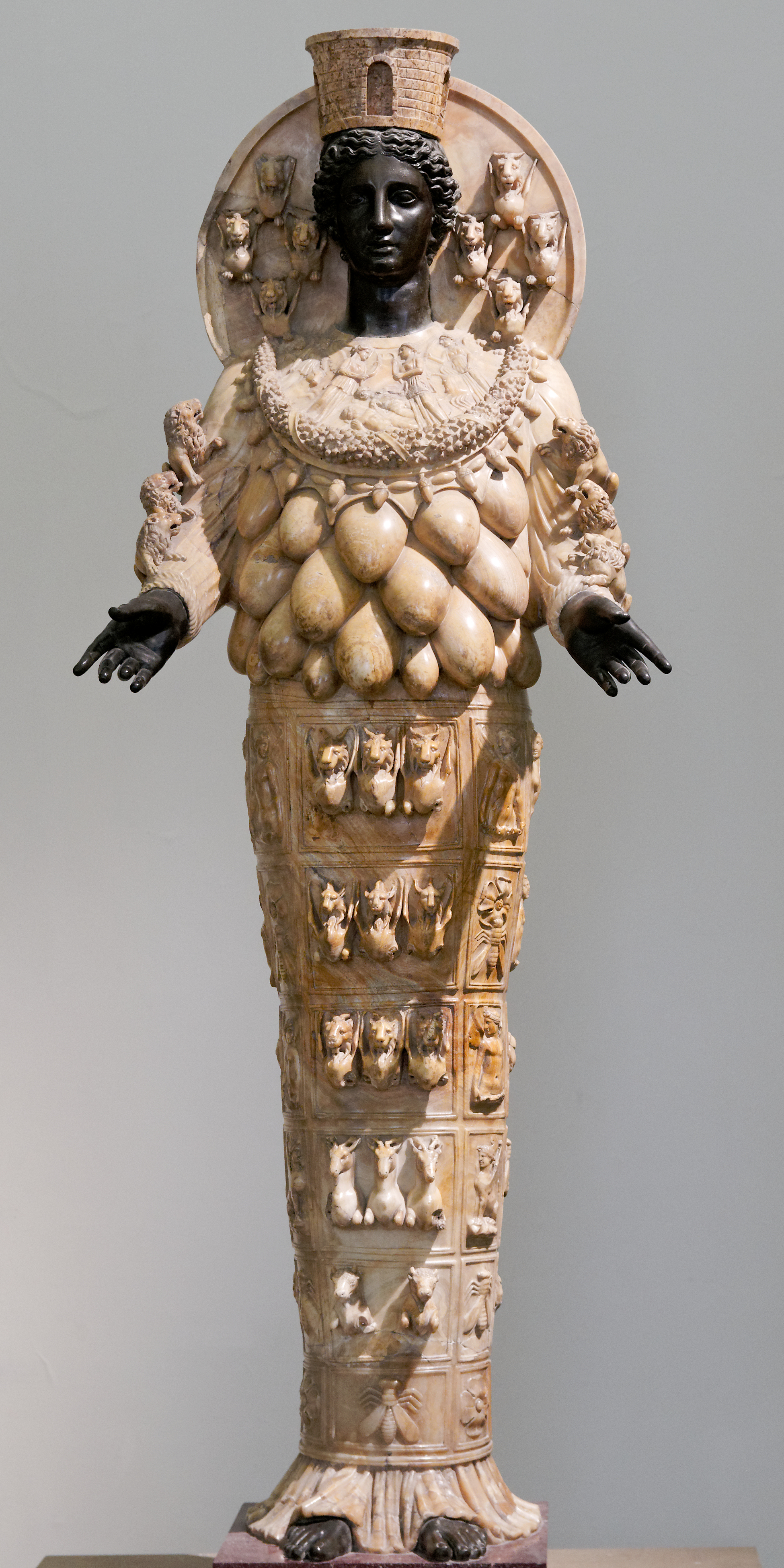
Artemis of Ephesus
I've always been particularly attracted to the name El Shaddai.  For me, it's always felt intimately attached to the marriage of Sarai and Avram (see this post) and, in a broader sense, to pre-rabbincal Judaism in general, a topic which is, you well know, close to my heart. When I pray extemporaneously, El Shaddai is almost always the name I use (although it depends on my mood and what I'm praying about, and Who shows up).  I knew about the "breast" connection and I knew that "sheddim" meant "demons" (although, in my experience, sheddim are really more like djinn or fairies than demons), but much of the information my rabbis provided was new to me.  

Thinking about all of this, I began to wonder, as I have before, about the connection between El Shaddai and the marriage of El and Astarte.  While "El" is the generic Hebrew word for "god" (little g), it's also a name for G-d, and the name of a specific Canaanite god.  El is strongly associated with bulls and thunder, is the creator of the world, and the husband of Ashera in Canaanite mythology.  Shaddai, if it does indeed mean both "breast" and "destroyer" could not be more closely aligned with Ishtar/Astarte, a goddess of sex, bounty, and conflict. Less well known is her patronage of pregnant and nursing mothers.  In the eastern parts of the Greek world, this goddess was known as  "Artemis of the East" or "Artemis of the Ephesians".  The statue in her temple at Ephesus, one of the Seven Wonders of the World, emphasized her role as the patron of nursing mothers, both human and animal, connecting in with the child bearing motif RK mentioned.  Fun fact: there is an interesting episode in the "New Testament" where her followers almost manage to stone Paul to death.  Too bad they missed!

Now, DDD translated "Shadday" as "God of the Wilderness", which it gets from the Akkadian "shaddu", or "dweller in the mountains". From there, it traces to the Hebrew sadeh, or "uncultivated field" or "plains".  It says "Any El Shadday, is, therefore, a "god of the wilderness" and can be connected with the iconographical motive of the 'lord of the animals'...with the emergence of the plough and incipient statehood, the 'Great Goddess' of the Neolithic period gave way to a male head of pantheon...The neolithic 'lord of beasts' survived only in marginal communities...El Shadday may thus serve as a prime example of the long way that a deity from ancient Canaan and early Israel had to go to become part of Old Testament theology."  While I'm pretty skeptical about this etymology, it is fascinating for the Babylon/Pan imagery it conjures...this time with El and Babylon and Shaddai as Pan, instead of the reverse!


For me, El Shaddai is the most ancient form of the Jewish god.  Most of you have head me say that the central teaching of my Judaism is the Shema.  "Shema Israel, HaShem Eloheinu, HaShem Achad.", literally "Listen up, Israel.  G-d is our god, G-d is one."  For me, that's the crux of the matter.  The god of our people (the way Athena is the god of Athenians, or Artemis the goddess of the Ephesians) is the Ineffable ONE who moment by moment brings the universe into being.  How fucking amazing is that?  It's COSMICALLY arrogant in a way no other people could dream to be.

El Shaddai, for me, is the name I use when I want to speak to my ancestral god, our tribal god, the nurturing breast, the violent destroyer, the Self Originator.  Expect a sound file this evening (like this one)

The following sources were very helpful in writing this:
Random fun-facts I discovered on google:

  • There's a PS3 game called "El Shaddai: Ascension of the Metatron", wherein you play Enoch, and try to keep seven fallen archangels from destroying the world in a great flood.  Obviously, I am looking for a copy.
  • There's a Christian song called "El Shaddai" by Amy Grant; it's not very good.  When I was about 12, I was at a sleepover, and was asked if I minded if we listened to some Amy Grant music. After we listened to it, I got asked if I wanted to be saved. I awkwardly declined.  I never told my mother, because I thought she'd think I was "falling in with a bad crowd" and not let me be friends with those girls anymore.
  • Many people seem to associate "El Shaddai" with Psalm 23 (the lord is my shepherd...).  I'm not sure why.

Wednesday, January 29, 2014

Unless I'm Mythtaken: Puck Tells a Story (guest post)

When I suspect students haven't done assigned reading, I make them record themselves reading it aloud and send it to me.  I think they suspect I don't listen to them, but I do (sometimes).  Puck has taken to inserting random "dramatic readings" of his writing into them.  Here's an excerpt from the very end of last night's homework (which ended with a table of trigonometry formulae)  This is a quick transcription, so it's probably not perfect.  Audio file at bottom of post.

"[20 minutes of trigonometry]...cos(x+y)=cosxcosy-sinxsiny...these are...oh, I can see the pattern, and sin(x+y)=sinxcosy+sinycosx ..... I got it, I got it, it becomes obvious how these work after a while.  [another student in background]  "Can you pause it so I can get through..."  [brief silence]  Thank you for making it this far.  Now, as I've finished that, I think I'll continue with a dramatic reading of my novel ... I'm not so great at telling stories, so bear with me I guess.  This story was told to me in the form of a long series of nearly incoherent screams by a homeless man who often sits on the front steps of my apartment building.  His name was, and still is, Chrio, though he insisted, especially in his sudden fits of shouting, on being called [spooky voice] Krioformus, Bearer of the Ram* [end spooky voice].  I've interpreted him as best I could, between the bits of his sudden storytelling I managed to record on my phone, most of which was nearly impossible to understand...

[I've cut several minutes out here]

...within the wrappings of the coils of the generator that breathes life into the universe, life coagulates into the solidity of consciousness.  Bread is not the stuff of life; water is life, and bread its complexity and purpose.  Within the gluten of the bread we find stories, pieces of inspiration that allow us to bend the iron bars of reality's cage and escape, for but a moment.  Bread is more than the sum of its ingredients, and so are people.  That makes you unique..."

a Kriophorus statue from the Acropolis
*Kriophorus is an ancient epithet for Hermes, often translated as "The Good Shepherd", but meaning, more literally, "who Carries the Ram".  It's particularly associated with Hermes in Arcadia (his birthplace) and denotes his role in carrying the "essence" of burnt offerings from Earth to the Heavens. It's the origin of the association between Hermes and the angel Sandalphon, who is often describes as plaiting the prayers of the faithful into wreathes and delivering them to the Almighty.


Have I mentioned that I fucking love this kid?!?!

Sunday, January 26, 2014

The Thunder, Perfect Mind


The Thunder, Perfect Mind is a gnostic poem from the Nag Hammadi corpus.  Since the first time I read it in my early 20s, I've always been very drawn to it.  For me, it's most closely associated with Shekhina-El.  (the presence above you in the LBRP or B'Shem Hashem). I wrote a little about B'shem Hashem here.  There's also a link to a recording of Neshama Carlbach singing it there.  Apparently, she associates B'shem Hashem with lightning also.

My recent Shakti work has brought it to mind again.  I've made a recording of it.  If you'd like to experience the feeling I get from the poem, and from Shekhinat-El, just listen to the recording while in a trance state.  You might want to do a LBRP or B'Shem Hashem first to call the Presence.

The drumming in the background is by Michael Drake.  It's his "lightening being journey" and can be purchased for $1.  If you like it, please buy it.  I highly recommend his drumming, check out his other stuff too.   He also has instructional cds, which I can't vouch for, but seem like they'd be awesome. (Puck, you should check them out and report back to us.  I'm especially interested in a review of this one.)

The "music" in the background was originally this, but I've pretty heavily altered it.  All the sounds on this site are great.  I recommend it too, and am a donor.

The complete text of the poem, in two different translations, can be found here (George MacRay) and here (Anne McGuire).  The recording hews closely to the MacRay translation, but at a few points, I felt moved to say it a little differently, and I did my best to fill in the gaps where the text was missing or corrupted.  Listen.

I'm very eager for feedback on this.  Please let me know what you think of it if you listen.  It's just over 16 minutes long.  There are no isochronics, but the drumming has a quite similar effect.  I wouldn't listen to it while driving or etc.  Unless you have high quality speakers with subwoofers, I'd recommend headphones.

In response to questions:
1) I didn't alter my voice.  That's just what I sound like when I'm in trance.
2) That's not EVP in the background near minute 6; it's my noisy upstairs neighbors.

Sunday, January 5, 2014

Untying Kundalini Knots

First, read this: http://www.magical30.com/2014/01/kundalini-necklace-sunday-15/  This blog post is the "more details" I promised.

If you don't understand what I mean by "4 or 5 dimensional space", you might try this article: http://www.pitt.edu/~jdnorton/teaching/HPS_0410/chapters/four_dimensions/index.html
I assign this article to 13-year-olds, so I'm sure you can manage it.

Recall: By necessity, all of this is, to some extent, metaphoric.  Where I feel like the metaphors are particularly misleading, I tried to use "scare quotes".

Disclaimers done, here we go:

To begin with, a brief description of the problem.  For various complicated reasons I don't really understand, our internal energy channels can get "gunked up" in multiple ways.  The first way is that psychological/karmic  "plaque" can get stick to the inside walls, like cholesterol inside a vein.

These blockages can be flushed out (at least it's been working for me) by imagining a warm bubbling fluid passing through the channel melting/dissolving them.  Once they become "unstuck" they can be flushed out through normal bodily processes (exhalation, excretion, menstruation, etc)  I find listening to running water sounds quite helpful in imagining this.
(start the video at 1:06)


Another kind of blockage is like a bubble.  Popping these feels very much like popping your knuckles or cracking your back.  It is very satisfying, and a warmth spreads after they are popped.  I've been mostly doing this with belly dancing and pranayama, but I expect yoga or tai chi or any other kind of internal energy work would work equally well.

The last kind of blockage (that I've thus discovered; I'm sure there are other kinds) is more complicated.  It's like a knot in a garden hose.  This is where I do the weird 5 dimensional magics.  Because it is hard to explain things in 5d, instead of imagining yourself as a 3d person with a 2d channel inside of you, imagine yourself as 2d drawing of a person with a 1d channel (a line) running up your middle.

The channel runs up your center, and there is a knot in it.  To the (1d) energy in the channel, the knot seems like a wall.  From the 2d perspective (the paper), it's smaller and more complicated, but still intractable.  However, by "zooming out" to a third dimension (looking "down" on the paper), it becomes clear that the knot is twisted through the third dimension. The lines that appear to be "crossing" or "blocking" each other are actually going one "over" the other.  "It's like an overpass, not an intersection."

Imagine you have a coin on a piece of paper, and you draw large box around it.  How do you get the coin out of it's circular cage without crossing the line?  Just pick it up, move it over the circle, and put it back down on the other side.


That being said, some knots cannot be "pulled apart" even in 3d (without passing an end through a loop, but since the channel is actually a loop, that's not an option).  Even those knots, however, can sometimes be easily slipped apart in 4 or 5d.  However, while we humans can see the underlying 4d nature of the problem, and even grasp its 5d nature, actually manipulating things in 5d is not a thing I can do (and I'm really quite good at visualizing 4 and 5 d stuff compared to most people.  I spent many years and most a phD in theoretical math training to do just that.)  This diagram may or may not be clear to people who do not have that training:

Similarly, a kundalini knot is a 3d channel "tied" through a 5th dimension.  Sort of like a klein bottle is a 3d channel "tied" through a 4th dimension.


So, instead of having to unknot it in 5d, you can do the crazy Vortex trick, which requires only 4d manipulation. Raise kundalini energy to the chakra just below the knot.   "Tie off" the chakra below the blockage, so energy can not descend from there.  Now, "tesser" by moving along a path perpendicular to the 3d knot.  (ie "pick the coin up" and move it "over" the "circle").  One you're on the other side of the knot, loosen the "cork" at the top of the "klein bottle".

I know that last part wasn't very clear.  I'll try to think about how to explain it better and try again soon.

Continue wiggling until the cork "pops".  The cork will then fall into the chakra below, and can be excreted as before.

Tuesday, December 10, 2013

That Shrewd and Knavish Sprite


The Dreamer, Monique Munoz
Lately, I've been doing some work with a secret magical order devoted to Hermes. (I have literally been waiting my entire life to say that sentence!) We've been talking about the various faces of Hermes, and I've decided to do a little bit of work with Puck as an avatar of the Mercurial current. Among my very first conjurations was an evocation Puck, when I was 14 or 15. He's been hanging around in my spirit court ever since.  It was based on a spell from the animated show Gargoyles (don't you judge me! I was a kid!) It requires a large mirror, a gold (colored) bell, a silver (colored) ring, some candles, a tree, the full moon, and a handful of white feathers.

Here's the spell as written in my first "Book of Shadows", dated 1993.

Around the edges of a large mirror, inscribe the magical characters.[gee, it would be cool if I'd written down WHAT magical characters, huh?  Stupid 14 year old me!  I wish I still had that mirror.] Lean the mirror against a tree at night, under a full moon.  

Light a white candle and a black one in front of the mirror.

Say: "Cum ascerat argentum, et aurum involare." [With a silver ring, strike a gold bell.] Tap the bell with the ring three times.

Blow a handful of feathers across the mirror, and say "postea Puck ad speculum Titania penetrare." [and then Puck will penetrate the mirror of Titania.]

On the show, Puck actually steps through the mirror, as if it were a portal. I didn't get that, but I did get a noticeable image, although fleeting. It was my first dark mirror conjuration (although I didn't know that name yet). Puck appeared as a late teen or early twenties (older than me - I am 14 in this story) young man, with very pale blond hair.  He wore a neon green Tshirt with a monkey on it, and a long black leather coat. He had small faun horns curled behind his ears. He seemed utterly delighted to have been summoned, although I lost my focus and it shimmered out almost right away.