Saturday, August 22, 2015

The Mighty Hippopatamus

A random memory: The summer between 2nd and 3rd grade we moved to a new school district. Very early in the year, perhaps even the first day of school, in gifted class, we were asked what our spirit animal was (obviously, it was not phrased that way; I don't remember the exact question...something like "If you were an animal, what animal would you be?") I said "hippopotamus". Now, as a fat girl, it was not a wise choice to say that out loud. I was teased unmercifully about it (and lots of other things) for some many years thereafter. Eventually, I denied I had ever even said such a thing, and tried to forgot all about it. I wonder what that does to a spirit-animal...mocking, denying, and forgetting them. This echos what has become of the hippo in modern western culture; they are considered comical. Well, I am reclaiming that part of me. Hail Hippopotamus! In restitution for this insult, I have made a sin offering to the WWF to "adopt" an African Hippopotamus.
Hippopotami are fucking awesome. While herbivorous, they are among the most dangerous animals in Africa; more powerful by far than lions, more aggressive than crocodiles. They have no significant natural predators. Among the Zulu, they are the symbol of bravery. A Zulu would be somewhat offended to be told he was "brave as a lion"; instead, a warrior is described as "brave as a hippo". In Egypt, they were considered a symbol of both male virility and female mother-protectiveness.
Of all animals on earth, the hippo is the most similar to that common ancestor of both whale and elephant; the wisest tribe of mammals. Alone among large animals, they are semi-aquatic. Legendarily, hippos sweat blood (although it is actually a reddish colored natural sunscreen they excrete). Hippos are a bit gender-queer (ie, they do not exhibit strong sexual dimorphism), and not particularly social. (just like me!)


Thursday, August 13, 2015

Sedna: Mother of the Cold Sea

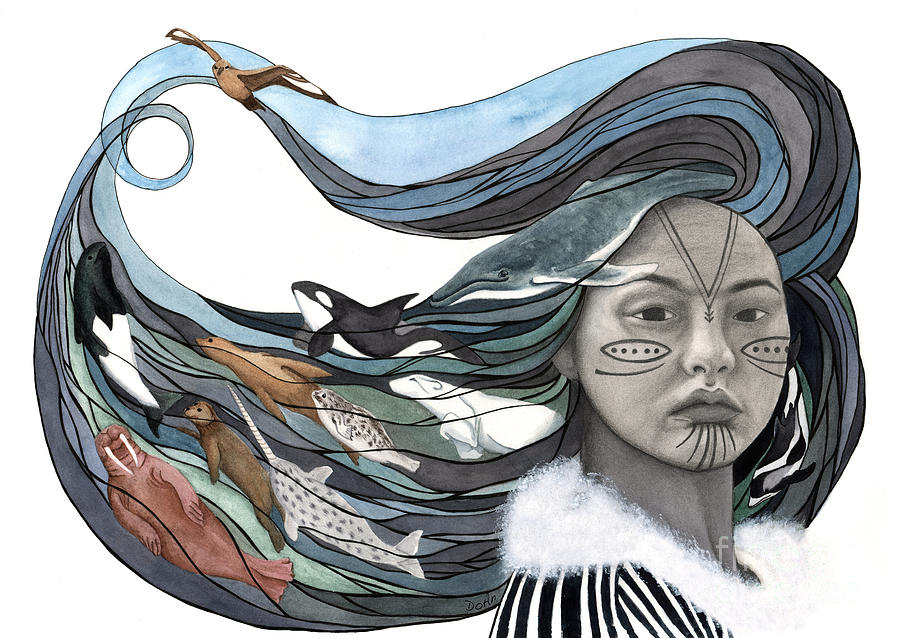
Sedna by Antony Galbraith,  http://fineartamerica.com


A friend and priestess of Apollo has recently told me that He says the single thing we magicians can do right now to help the entire planet is to work to strengthen the oceans.  In order to help, I've been instructed by Sedna to make her a sound.  Most of the gods and goddesses I work with come from the Near Eastern and Greek pantheons of my ancestors.  Recently, however, I've been starting to work with more American spirits.  Sedna, แ“ดแ“แ“‡, is the Inuit name for the Great Goddess of the Arctic Ocean; the Mother of Cold Sea.  While she is primarily known in the Arctic circle, I believe her to extend well into the Northern Atlantic, especially in Winter.  Wherever the icy arctic water reaches, there is Sedna.

My very first introduction to Sedna was in this folk song, by Canadian artist Heather Dale.

I immediately recognized my beloved cold-water goddess.  When I was young, my family went to the (midAtlantic) beach every year in the summer.  While my mother was not a fan, my father and I shared a love for the ocean.  One of my earliest memories is my father teaching me to jump waves..."put your arms out like superman, bend your knees, and as soon as you feel the sea begin to pull you, get ready, the wave is coming, get set....JUMP!"  Many years, especially after I was old enough to drive myself, I also visited in the winter, near my birthday (president's day weekend).  It was always clear to me that the ocean was ruled by different spirits at those times, and, as much as I love the summer ocean, it is the bone-cracking-cold winter Atlantic that holds my heart.

Sedna has a story for me to tell you, which isn't quite the usual story of her birth, but it is the story of how she came to be none the less.

Sedna, the 10th planet.
Sedna, the Mother of the Icy Seas.
Sedna, the Arctic Ocean, the Great Ice of the North.
The Gate at the Edge of Forever.
The Whale,  The Great One,
The Black Dragon of the North.
The Arctic Ocean.  The Great Wall of Ice.
The Daughter Sacrificed.
The victims, the daughters of the patriarchs.
The matriarch, deposed.
The Sea Witch.
The Daughter of Sea and Sky.
The Great Lady Below.

In ancient days, the ocean was cold, and still, and utterly lifeless, tohu wa bohu.
Father took Daughter out on the sea. 
A storm arose; Chaos blew over the surface of the waters.
Father was afraid.  Father blamed Daughter.
He cast her overboard, but she clung for life to the sides of the boat.
Father, afraid, took up the oar.  
Once, he bashed Daughter's fingers.  
Twice, he bashed at her hands.  
Daughter was cold.  Her hands turned to ice.
A third time, Father struck, and her fingers shattered. 
They fell into the sea and became whale, walrus, seal, and porpoise.  
Daughter sank down, to the bottom of the sea, and there she still resides.

So, it seems that's what Sedna had to say on the subject; I don't see how I could improve on that description (were it even my privilege to do so).

In lieu of physical offerings, Sedna desires charitable donations and work on behalf of the deep sea.
She will also accept the finest quality of eel sushi, thrown into the sea, north of the 45th parallel.

I have created an audio file at Sedna's instruction.  Listening to it will help you connect to Sedna, to all deep ocean spirits, arctic and other northern genius loci, and large arctic marine mammals.  It can also be used to help heal the teeth and jaws, the skull and spine.  

The sound also heals something else, something difficult for me to even explain.  This sound helps to heal mother-guilt, the injury done to the soul of a mother who (intentionally or not) injures her child.  It can heal your own mother-guilt, but also any ancestral/karmic mother-guilt you might have inherited. It WILL NOT heal father-guilt; I'll see if I can find someone else to take that on.  

It can also help heal the trauma experienced by a baby during a difficult birth, especially those of us born by cesarian section.

Sedna is not a friendly goddess;  she is mighty, wrathful, and does not give a shit about you.  DO NOT fuck around with her.   It is unlikely that just listening to this sound will provoke direct experience of her, but, should you find yourself in contact with Sedna, approach her respectfully.  The filth of humans poisons her children, chokes her seas, clogs her eyes and nose and mouth.  Our filth and waste is tangled in her hair.  Help her comb it out: gently, and lovingly, and in cognizance of your guilt.

This sound is VERY safe to use in the summer, or anywhere/when it is warm out.  A much more powerful, but potentially dangerous, experience can be had by working with it while cold, especially while submerged in cold water.  THIS IS FOR EXPERIENCED TRANCE WORKERS ONLY.

As with any healing magic, you might experience the "badness" leaving your body in a variety of forms, including as digestive gas, or emotional catharsis.  Try hard not to engage with / attach to anything the sound shakes loose, just let it flow out of you.  You might feel the need to move around your spine or jaws, and you might experience some popping as they subtly shift into alignment. However, if you experience pain, remove your headphones, turn off the sound, drink some water, and you will rapidly return to your normal state of consciousness.  Obviously, I'm not a doctor, and the sound can't substitute for actual medical care.  See a doctor!

Try to listen to it with headphones, or speakers with VERY good subwoofers.  There are some almost-too-low to hear sounds, including the so-called Pigeon tone, at 69.3 Hz.  

The audio opens with Heather Dale's song.  Please pay her for it!  You can buy the song (and many others!) here for $1.

After the song, the sound consists of various ocean noises, including nearly-subsonic fin whale signals recorded off the coast of Ireland.  Also included are a pseudo-solfeggio tone at 69.3 Hz, a a hollow mammoth tusk, a Tibetan frame drum, and a few other things.  There are no isochronics or binaurals; this sound is epileptic-safe.


Sunday, August 2, 2015

Throat Healing Sound

Surrender, by Mykal Aubry (mykalaubry.com).


Most of you know I'm quite active in the Strategic Sorcery group founded by Jason Miller.  On Wednesday, I and three compatriots joined dozens of other magicians all over the globe in preforming a global Mercury rite.  I'm not permitted to disclose the details of that rite (I really do highly recommend Jason's class.  Even if ALL you got was entry into the group, that would be well worth the cost.)

My working partners and I have had great results so far.  J won a free cruise to the Bahamas.  B inherited a jaguar (a car, not a panther) from a rich grandfather he's never met.  Lots of other more personal things have clicked into place for all of us, particularly in the realms of travel and communication.

One piece of tech from the ritual I can share is that it involves a layered drone chant of the letter epsilon.  (eh sound).   While experimenting further with the sound, I found myself assuming the godform of ibis-headed Thoth.  This is a godform I assume quite often before I begin teaching (my IRL job), as well as whenever else I feel extra intellectual/spiritual authority.  It's a relatively easy shapechange, which is mostly just elongating the neck and curving the central channel forward after it exits the top of the skull.  In any case, it happened all on its own, and I received a very clear teaching on how to use the sound to heal both the physical neck, throat, upper spine, thyroid, and teeth, but also the energetic throat chakra and its associated channels and whatnots.  The sound below was primarily designed by Thoth -Hermes, although he consulted Asklepious (a spirit I only recently met, while in Greece.  I'll tell you soon all about my experiences at the Asclepion of Epidarus).

I have a friend currently recovering from serious neck surgery, so I'm hoping that this was especially designed for him, but I certainly felt lots of crud clean up in my neck while I was making and testing it.  Please report your results back to me, either directly, or in the comments below.  UPDATE: Turns out I have a number of friends with less severe neck injuries as well.  Y'all need to take better care of your necks!

To use it, all you really have to do is sit or lie down and relax, while listening to the sound.  It will help if you can vocalize or hum along, but you don't really have to.  More complete instructions can be found here, and the sound itself is here.  Headphones are not necessary, but even low-quality headphones produce better sound quality than all but the best speakers.

The sound includes drone-chanting by myself, Jason Miller, and Jesse Dollar, some bells and Tibetan singing bowls, the 741 hz solfeggio harmonic, and some other aural goodies.  There are no isochronics or binaurals; this should be a very safe sound for everyone.

If you send me a recording of yourself saying "ehhhhhhhh", I will mix it in.  Why should you bother?  Two reasons...
(1) this will make the sound dramatically more potent for you.  The sound of your own voice mixed in will help you rapidly and fully attune to the noise.  At least personally, I find nothing so enchanting as the sound of my own voice ;)
(2) It provides a direct sympathetic link between you and the sound, so that you receive "trickle down" healing whenever anyone uses it.  (think of it like a Tibetan prayer wheel, accumulating blessings with every turn).

Thursday, July 30, 2015

Aphaea, Clay, and the Goddesses below the Earth

The Temple of Aphaea at Aegina

On the island of Aegina, where we visited the ancient temple of Aphaea, a little know huntress goddess of nets who has been syncretized with Athena, Artemis, and maybe even Astarte. Aphaea, by that name, was worshipped more or less only at Aegina, although she was also known under the name Diktynna of the Nets on Crete and as Britomartis in Minoan culture. Britomartis is also a character in Spencers' Fairey Queen, where she is a Maiden Knight. At her temple on Aegina, I got a very Hekate/Artemis kind of a vibe, with a bit of Astarte around the edges. It's a lovely temple, high on a mountain overlooking the sea, and pretty far off the usual tourist track.  The hill surrounding the temple is wooded, mostly with a kind of pine that smelled very crisp and clean.  I wold like to visit again when it is not so brutally hot.  There was no one but our group there the day we went.  However, it was referendum day.  Here on Aegenia, things have been quite calm, but I think it is more heated in Athens.
photo from Phaidon.com

The temple is lovely, and in good condition.  It feels distinctly Artemis/Hekate-ish.  It reminds me, particularly, of the stories of the two of them together.  I think people forget that their mothers are sisters.  Hekate once told me a story of how she gave up her fertility to her cousin, and took, in exchange, Artemis's inheritance of day-prophecy from Leto.  It was a great work of magic.

Aphaea brings also to mind Hekate as a daughter of the Sea.  While most sources say that Perses is Hekate's father, to me, I have always understood her to be, at least in some sense, the daughter of Asteria and Okeanos, of Sky and Sea.  In nearly every culture, there are (at least) two ocean spirits; a goddess of the beach, and a god of the depths.  Hekate's kinship is not to the Aphrodite-warm ocean waves, it is to the primal, deep, cold, cthonic reaches.  The ocean whereof all life arises, and into whose cold depths we all return.  And yet, here, on Aegina, the Aegean ocean sparkling in the July sun, Aphaea seems a goddess of light and heat and youth.  I have a brief vision of a mermaid-tailed herbalist, smelling of pine and pistachios, a patroness of young women exploding into their own power.  My best friend when I was in high school, and to this very day, is a beautiful woman, with a wild mane of blonde hair.  She is a master herbalist, an acupuncturist, and a naturopath.   In our youth, she was devoted to Artemis.  She now has a newborn daughter.  Like us all, she has grown and changed, becoming every more amazing, as we've grown up.  To me, Aphaea feels like her, like grown-up Artemis, daughter on her hip, an accomplished healer who lives by the sea.

After we left the temple, we went in search of the last traditional potter on the island. I have always been interested in pottery; I did some of it in school, and so this was very interesting to me.  All we had by way of an address was "Nektarios Gkaris the Potter, Aegina". However, the gods smiled on us!  Our bus driver turned out to be Nektarios' cousin. (This is not quite as unlikely as it sounds; to us Greeks, "cousin" means anyone you're related too.  My family was one of the first Greek families in Lancaster; now nearly every Greek person there is my "cousin".)

Our bus driver took us to visit his studio; a small ramshackle building completely stuffed with pottery and cages full of parakeets. At a place of prominence, where he could look out the window while working, was his potter's wheel, and behind it the kiln. Nektarios spoke very little English, but our guide translated for us. He said that he had learned the craft from his father, but he had no children and no one to pass his craft onto, and so the ancient techniques of Aeginean pottery will die with him.

He digs his own clay, but all the land he used to dig on has recently been privatized, and so it is now very hard to get local clay; he does not know how long he will be able to continue.  He told us that, in the 70s, the federal government had funded a school on Aegina for pottery and other folk-crafts, but that corrupt local politicians had sold off all of the equipment. (I think; it was very crowded and hard to hear) 

I bought several things from Nektarios.  See the large Hermes plaque inside the door?  I got a tiny one just like it.  Among the things I got (and now I'm wishing I'd bought many more things, and shipped a box home) was a plaque of Theotokos (Mary, mother of Jesus).  I wasn't really sure why, but it called to me.  At the time, I said it was for my (late) grandmother, and I thought maybe I'd put it by my ancestor alter.

After I got home, I painted up some of the pottery.  Here's my Hermes, at home with the egg: 

Here's a replica of a Cretan sistrum, which I've painted Mycenaean style with a mixture of red paint, my blood, dittany of crete essential oil, and flying ointment.  The sound it makes is not entirely satisfying.  Many people think that these sorts of clay sistra were never intended to be played, but are simply grave goods, props.  Already, with limited use, the clay disks are starting to chip.  When they break, I will replace them with metal ones, which I think will produce a better noise.
And here is Theotokos (which is not quite done being painted)
At first, I wasn't really sure why she wanted to be so dark complected.  I knew there was a thing called "Black Madonna", but I didn't know much about it.  After a very fascinating and informative talk with my friend Michael, I am COMPLETELY convinced that Aphaea and the Black Madonna are both avatars of the goddess I call The Great Lady Below.  I often work with her as Ereshkigal; I think she's who a lot of Wiccans connect to when they work with Hekate (although I don't read Hekate that way at all).

Black Madonna, by Ulla Karttunen

To me, the primary attribute of the Lady Below is her chthonic nature; she is the deep, rich Heart of the World, from which both healing and death emanate; she is white as bone and dark as night.  She taught us to forge the very first stone blade, and gave us homes in her sheltering caves.  Before agriculture, before the domestication of animals, it was She who provided everything; mother, sister, lover, priestess, teacher, and undertaker.


Monday, July 6, 2015

St George, the Dragon Tamer


Today is my last day in Greece.  I fly out tomorrow morning.  It's also the first day I've set out on my own, instead of with the group.  It's been an amazing trip; I'll write you all about it over the next week or so.  Right now, however, I want to write to you about this monring while it's still fresh in my head.  Just after a lovely breakfast (fried egg, kalamata olives, feta, fresh tomatoes (the tomatoes in Greece are fabulous right now!), and water melon), I set out for Mt Lycabettus, and the Chapel of St George.


Mt Lykabettus, the "mountain of the wolves" is one of the "seven hills of Athens".  The legend goes that the mountain was brought to Athens by Athena, who dropped it from the sky when Ercthonius was released.  

What was on the hill in ancient days seems to be a matter of some debate.  Some sources say that there was a temple to Zeus, the "Dios Oros or Mountain of Jove, which was the ancient Mount Anchesmus as mentioned by Pausanias". Some say it was empty until the Byzantine era, when a church dedicated to St. Elias was built there.

Rather than climb the mountain on my injured knee, I took a taxi to the base, and then the incline to the peak. While it was much hyped, I found the incline quite unimpressive.   The Lykabettus furnicular is not nearly so long as  the Duquesne or Monongahela inclines, and it is entirely enclosed in a tunnel.  However, the few other tourists on the ride seemed much impressed with it, so I suspect if you're not from Pittsburgh, it's awesome.


When you reach the top, you walk out onto a garden path, and from there can make your way to a rather hidden observation platform, with astounding views of downtown Athens, and of the chapel above.


Making your way back to the path, which is full of white and pink azaleas in full blossom, you come next to a small cafe, playing lounge music.  It was only 9:30 am when I got there, so the cafe, which has amazing views, was quite empty.  Continuing up another flight of the brightest white marble stairs, you come to the chapel itself, and the bell tower.  


The chapel is quite small, and completely covered in Byzantine-style iconography.  Most prominent are Xristos, Theotokos, and, of course, St. George.  Now St. George is an awesome fellow.  He is most well known as a dragon slayer, but, in the oldest stories, he is a dragon tamer..

In days long past, St. George was traveling through a far off land (some say Libya, some Egypt, some other places).  He came upon a city (some say the city was Silene) draped in the black of mourning.  Inquiring as to the cause, he was told that a dragon had been terrorizing the land.  In order to appease the dragon, it was decided to offer it a young maiden as a bride.  Lots had been cast, and it came to pass that the unlucky duty fell on the king's own daughter, the much beloved princess Sabra.  Fortifying himself with the sign of the cross, Saint George set off on his horse to kill the dragon and rescue the princess.  Soon, St. George came upon a wizardly hermit, who led him to a magical orange tree, whose fruits were proof against poison.  After harvesting some oranges, St. George set off for the lake where the dragon resided.

Coming to the lake, St. George found the princess Sabra dressed in a flowing bridal robe of white silks, chained to a rock, terrified, awaiting her draconian groom.  The dragon, its scales shedding water, was slinking up out of the lake.  It's head was immense, its venomous breath foul, and tail was fifty feet long!  Quickly, St. George freed the princess, and gave her one of the magical oranges.  St George struck the dragon with his spear, but the scales were so hard that the spear broke in half, and the dragon began to hiss and splutter, a horrible serpentine laugh.  Venom dripped onto St. George and the princess, but they were safe, thanks to the magical oranges.

St George threw himself at the dragon, but this time his sword broke.  He fell to his knees between the dragon and the princess, ready to give his life to save her.  Then, the princess, having recovered her wits, stepped around George, and threw her girdle over the dragon's head, like a leash.  At this, the dragon followed the girl, as meek as a lamb, back to the village, where it was set to work heating the smith's furnaces.

(several more versions of this story can be found here)

Now, as you might have noticed, this story has very little to do with Christianity, and almost all sources agree that it predates the church.  Some believe St. George to be an avatar of Sabazious, some of Zeus.


After taking many photos of the stunning views, I entered into the beautiful chapel.  


After the brilliant sunlight, is was cool and dark, and very welcoming and powerful.  I began to weep.  I can't really say why, the feeling of wonder and love was breathtaking.  The little old lady who was sweeping the stairs offered me her handkerchief to wipe away my tears.  I made a small donation, and took a beeswax candle, to light.  Setting the taper in the sand, I prayed for my ancestors and for peace and freedom for Greece.  I am so worried about the Greek people; things are beginning to unravel here, and yet everyone is so friendly and warm and wonderful.

While I was praying, several obnoxious Australian teenagers came in, and began talking loudly, and snapping photos.  One of them said "Look!  She's actually praying here!" (which seemed like rather an absurd thing to say in a church).  My concentration broken, I went back outside, pulled myself together, and played tourist a bit more.

After about half an hour in the sun, with temperatures climbing into the 90s, I retreated to the cafe, drank an very sweet iced cappuccino made with evaporated milk (a Nescafe Frappe; this is apparently how Greeks drink their coffee in the summer.  quite good.).  I took a few more photos (see facebook for ALL the photos, including numerous selfies), and read for about 2 hours.  While in Greece, I have been rereading Nikos Kazantzakis' masterwork, Report to Greco.  This is my 5th or 6th time through the book; I never tire of it.  The semi-biographical novel is addressed to the Cretan painter El Greco, here understood to be an ancestor of Kazantzakis.  Written on his deathbed, Report to Greco is, in many ways, Kazantzakis's ode to Greek-ness, to the life of the spirit, and to his beloved Greece, and his Cretan homeland.  Kazantzakis's voice is my constant companion here in Greece.

"I LOOK DOWN into myself and shudder. On my father’s side my ancestors were bloodthirsty pirates on water, warrior chieftains on land, fearing neither God nor man; on my mother’s, drab , goodly peasants who bowed trustfully over the soil the entire day, sowed, waited with confidence for rain and sun, reaped, and in the evening seated themselves on the stone bench in front of their homes, folded their arms, and placed their hopes in God. Fire and soil. How could I harmonize these two militant ancestors inside me? ... Without knowing it, the entire universe follows this method. Every living thing is a workshop where God, in hiding , processes and transubstantiates clay. This is why trees flower and fruit, why animals multiply, why the monkey managed to exceed its destiny and stand upright on its two feet. Now, for the first time since the world was made, man has been enabled to enter God’s workshop and labor with Him...The age-old paternal ancestors are thrust deep within me; they keep fluctuating, and it is very difficult for me to discern their faces in the fathomless darkness. The more I proceed in my search for the first terrifying ancestor inside me, piercing through the heaped up layers of my soul— individual, nationality, human species— the more I am overcome by sacred horror. At first the faces seem like a brother’s or father’s; then, as I proceed to the roots, out of my loins bounds a hairy, heavy -jawed ancestor who hungers, thirsts, bellows, and whose eyes are filled with blood. This ancestor is the bulky, unwrought beast given me to transubstantiate into man— and to raise even higher than man if I can manage in the time allotted me. What a fearful ascent from monkey to man, from man to God!"

Eventually, around midday, my frappe long gone, the sun and heat became oppressive, even in the cool shade of the azaleas surrounding the cafe.  I rode the incline back to the bottom, and, despairing of finding a taxi, I began to walk down the great hill.  I walked down a narrow alley, with orange trees along both side.  Oranges, in various states of decay, lay in the gutters and along the sidewalks.  I, of course, ate one.  It was somewhat mealy and not very sweet.  I assume, however, that I am now immune to dragon venom, so all is well.  An occasional motorbike rushed past, far too fast for reason.  After several blocks, one a staircase, I came into a sort of town square, full of phenomenal street art I wish I'd photographed.  I caught a taxi back to the hotel.  After a soak in the jacuzzi (from which you can see the parthenon; be jealous!), I retired to the hotel bar to write this.  Finding myself now at the present, I bid you farewell from Athens!  


PS: If you like my writing, I've recently started a Patreon campaign where you can help support it! ANY amount of support (starting at just $3 per month) comes with access to brand new mythopoetics you can't read anywhere else.





Thursday, July 2, 2015

A Hymn to Hermes Written on a Bus from Mycenae to Olympia


The Arcadian Hymn to Hermes

Listen now, as the muses sing
of Hermes Mercurius, the Quicksilver King.
Teacher of teachers, the Universal Mind,
Arcadian child of Mฤyฤ, divine.
Mathematician, Magician, Traveler, Thief:
Make the pious man doubt, and bring the skeptic belief.
Make our words be clever and our eyes to be bright.
Grant unearned luck and true wisdom’s insight.
Let our tongues be quick; make our feet quick too.
Let our lies be convincing, but our teaching be true!
Send instructive dreams and controllable visions,
Ennoble our purpose, empower our missions.
And when, at last, our lifetimes end,
be our beloved guide, and our psychopomp friend.

Wednesday, July 1, 2015

The Eleusinian Mysteries

Most of you know that I am traveling most of this summer.  For the last several days, I have been in Greece.  I will write up all of my experiences when I have time (if you're my IRL friend, follow along on facebook!)   Today, however, my experience was so profound that I wanted to write about it while it was still fresh.

First, to answer the most common question I am getting:  It is very safe here.  There are very long lines at ATMs and sometimes they are out of cash.  We have been advised not to use an ATM alone at night (which seems like generally good advice) but other than that, all is ok.  Greek citizens can only take out 60 euros per day, but accounts on foreign banks are still fine.  Tourist places still take credit cards, but some want cash.  I am more eager to spend than I usually would be; I am so worried and sorry for all my Greek friends; things are tense.  However, for tourists, things remain very much as normal.  If you are thinking about coming to Greece, don't let this scare you off!

A brief summary of my trip so far:  I got into Athens Sunday evening after a long unpleasant trip.  I met up with my group (of pagan friends and new friends), and the next day we went to the Acropolis.  It was a difficult climb for me in the heat, but well worth it.  Athena is very strong there.  We then went to the National Archaeological Museum, where I had quite a moment with a Kriophoros statue. (TONS of photos on facebook)

The next day, we went to the Agora, including the Temple of Athena & Hephaestus.  It was cool, but not my favorite thing so far. (photos on facebook)


Today, we went to Eleusis, seat of the Eleusinian Mystery Cult, the most famous of the ancient mystery cults.  The mysteries began as an agricultural fertility cult centered around Demeter, as early as 1500 BCE.  In fact, Demeter, whom I never cared for as a child, but who comes closer and closer to me as I grow, is among the oldest of the Greek gods; her name appears in the Linear B tablets.  Eleusis is an ancient "satellite" of Athens; its about 20 km north of the city.  In addition to being a sactuary of Demeter, the Great Goddess of Grain, Eleusis also is sacred to both her daughter Persephone and Persephone's husband, Hades.  If you don't know the myth of Hades and Persephone, then (1) I can't imagine you read this blog, and (2) Go read it before continuing.
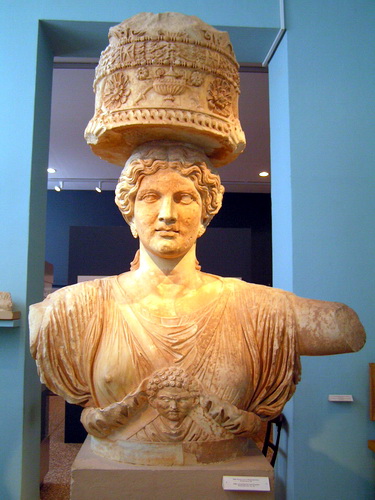
Demeter, called "St Dimitra" by locals.  This statue
was still venerated in 1803, when it was looted
by the British.  At that time, Eleusis was
among the most fertile farm land in Greece.
After the statue was removed, it rapidly devolved
into a polluted industrial wasteland


Eleusis is the first ruin we've been to that isn't over-run with loud tourists.  (I understand that I am also a loud, obnoxious, hypocritical tourist.)  Our guide says that most tours don't go at all, and she was happy to take us, because she really likes it.  It was amazing to be able to walk among the ruins, clambering over them (respectfully!) like I imagined.  The Acropolis was very heavily controlled, with guards EVERYWHERE (although it is possible that there were extra because of the current situation).  Having grown up in a tourist spot (I was briefly a guide, in fact), I always appreciate going places that are further "afield".

I was busy BEING there, so I didn't take a lot of pictures at Eleusis, but this site has REALLY extensive photos and a map.  You can see a few of mine below, and a couple more on facebook.  When you first enter into the site from the processional road from Athens (which was more or less the route we took, although we came by a large pink bus.) you are in the outer courtyard, where non-initiates gather.  In this area are several shrines to a variety of gods; I spent some time with Artemis and with Papa Poseidon, the gods of my youth.  

After that, you then (if you don't walk "through walls" that aren't there any more) pass through three large gateways, about 6 steps apart.  These gates were open only to initiates of the mysteries.  I did this very intentionally and slowly, trying to really enter into the mysteries, to find an initiation.  

To this day, we do not really know the exact content of the rituals of Eleusis, but their central promise was to free the initiate from the fear of death.  Before entering into the Eleusinian rites, initiates fasted and then consumed a fermented barley potion called the kykeon.  Some people think it was entheogenic, however the expert of our group says that it was made with pennyroyal and perhaps wormwood, and induced near-death experience.  Pennyroyal is only moderately toxic to adults, but fatal to fetuses and infants.  It's most common medicinal use is as a parasite killer and abortificant, but it is also used to induce menstruation in women whose period in delayed for some other reason.  It is a plant I grew and worked with as a young woman.  She is a beautiful plant, with spikey purple flowers, but a difficult teacher.

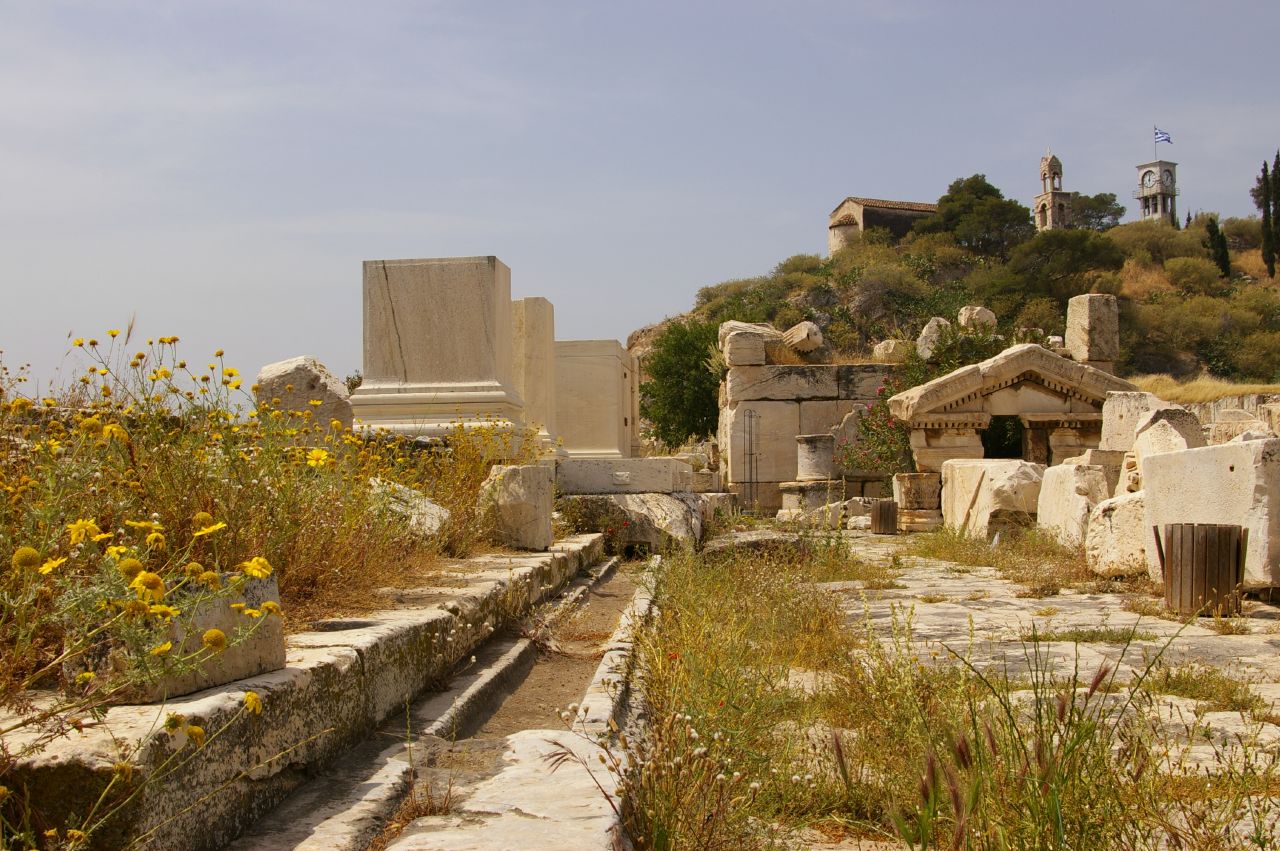
In any case, after you pass through the gates, the next thing to your immediate right is the Plutonion, the abode of Hades.  In days of old, there was a temple building, but only priests were permitted within it.  walking around the temple, and up a slowly ascending curved staircase, you are faced with a shallow cave, really just an overhanging rock shelter, soot black on the top.  I assume that it was this that was the most original sacred site.  I have never been at a more powerful location.  Legend says that it was here that Persephone returned to Earth from Below, a true entrance into the underworld.  It looks far less impressive in the photos than it was to me, but this is a true Place of the Old Powers, an entrance into the Womb of the Earth.  


As you enter in from the staircase (left), the first thing you see is the altar/opening where several visitors before us had left flowers and pomegranates.  We also picked wild flowers and laid some, and we poured out water.  I have been taught that, because our modern water is so clean and so pure, it is the most wonderful offering, an acceptable substitute for any other gift.  Many people sang here as well.  I waited for the others to finish here, because I wanted to spend some time.  After connecting, I poured out some water, and then put my finger in the mud, and drew a gritty red line from my hairline, down my forehead and nose, down my chin, and as far into my cleavage as my clothes allowed.  I felt the need to do so before entering into the underworld, which I did through this opening.  Even now, as I look at the picture, I can see a face staring back at me from this cleft in the body of the world, beckoning me back.


After that, there is a larger depression, with a shallow shelf, about 5 feet off the ground, and about 4 feet deep.  The photos below don't really give a good sense of it.  The darker parts are exposed veins of black marble running through the surrounding (lime?) stone.


After standing for a while under the rock hang, I felt the need to enter deeper.  I crawled up to the shelf.  My group left, to continue up the hill to the sacred place of Demeter at the top of the hill.  I stayed.  For about half an hour (maybe longer?), I lay in the underworld.  I put (2 euro) coins on my eyes.  I sobbed hysterically.  And then I quieted.  And then my body decayed, and my skeleton rotted away to dust, and I entered into the underworld.  I cannot yet really tell you what happened while I was there.  It's still too fragile to be made literal, but if I can, I will tell you about it later.  It was probably the most profound religious experience I have ever had.  

Eventually, I came back to myself, and I climbed down.  I sat in the sunshine and rapidly drank almost a liter of lukewarm water.  I then retreated to the shade, and braided wheat straws.  By that time, the rest of my party was coming down the hill.  I am hoping I will have a chance to return to Eleusis on this trip, but I do not think I will be able to.  I will come again.

I later discovered that, while I was in the cave, I began to menstruate, which is symbolically cool, but logistically irritating.  My birth control is supposed to prevent this.  UPDATE:  I menstruated, after that, for nearly 6 weeks.  My doctor said it was a reaction to the birth control, but I think not.  Not only for mystic reasons, but because I've been on depo provera for more than a decade, and that's never happened before.  I think I was cleansed, at Eleusis, of my fear of death, and I bled out the last of a compact I made long ago.  I cannot tell you too much about it, but I gave away my future children (which I was happy to never have) to one who could not conceive, and received something very precious to me, but unwanted by her, in return.  

More on Eleusis here and here.