Wednesday, March 23, 2016

Ishtar Rising

Goddess of the New Light, by Pamela Matthews


As the sun drops below the horizon, and the moon, pregnant with longing, rises up over the new born Spring, the wheel turns, and Ishtar awakens in the underworld.  She has slumbered long, too long, here in her sister's realm, in the realm of the Dead, where the rivers run only with dust, where the polluted sea meets the bitter land.

Ishtar awakens, the Purim moon rises, Death gives way to the Spring.  Ishtar, Gleaming Goddess, Shining One, Torch of Heaven, Daughter of Morning, Herald of Day, Ishtar stretches, and shudders, and laughs and sighs.

At her right, Justice.  On my left, Goodness.  Set like stars in my crown shine Audience, Favor, and Peace.  All around me shine Life and Wellbeing.

Clarity!  Brilliance!  Dominion!

The way ahead is bright.  The way ahead is clear.  The way up from below, up from beneath, the way up and ahead is clear and bright.

The first step out of the underworld.  The deepest gate, the seventh gate, the root at the center of being.  The gate thrown open, I pick up my dress, sparkling white, radiant and agleam with power.  I put on my dress, sparkling white, radiant and agleam with power.  I, myself, am sparkling white, radiant and agleam with power.

The sixth gate, the azure gate, the stillness and quietude of the abyss.  The gate of Marduk thrown open,  I pick up my robe, indigo blue, the robe of the heavens, the protective shield of the gods' love  I put on my robe, indigo blue, heaven's grace, the protective shield of God's love.  I, myself, am indigo blue, am heavenly grace, the Beloved of the God of the gods.

The fifth gate, the gate of the flesh, the cauldron of breath and of flame.  The gate of Fire thrown open, at last, I pick up my sword and I wield it.  I pick up my swore, aflame and enflamed, strong and true and brave, the sword of my will and my breath.  I wield my sword, red and shining, strong and true, the sword of my breath and my flame.  I, myself, and red and shining, strong and true, a sword of will and flame.

The fourth gate, the gate of the sun, the golden gate at the center of Being.  I pick up my heart, polished by flame, strong and pure and alive.  I swallow my heart, feel it slip slide to my chest, slick and beating, alive.  My heart is warm, polished in flame, strong and pure and alive.  I, myself, am warm and enlivened, polished and strong and pure.

The third gate, the malachite gate, the gate of the forest and rivers, Ishtar's own gate, the Lion's gate, the gate of the hands and the throat.  I pick up my necklace, of amber and lapis, my necklace of joy, gold, and gleam.  I wear the necklace of joy at my throat, the rune the tells blessing and light.  I, myself,  am the Amber-Haired Queen, the Golden One, Gleaming, I shine.  I myself am Joyful, am Blessed, am Light that shines through the leaves.

The second gate, the Quicksilver gate, the gate of the throat, of the tongue, of the Word, the gate of the Name of the Lord.  I pick up my voice, long lost, long silenced, my words and my wiles and wit.  I shout out in joy, I speak poems and hymns, my lips drip with honey and wine.  I bellow my words I whisper my wiles, I write blog posts that showcase my wit.  I, myself, am wiley and witty, I myself am Brilliance and Shine, I myself am the Word of the Making, the Quicksilver Speaker of Fate.

The first gate, Phoebe's gate, Shining One, Grandmother Mine.  The gate of oracular insight, the gate of the clearest of minds.  The gate is thrown open, I pick up my crown, the crown of the moon and the stars.  The eight-pointed gem gleams at the center, the crown of the Queen of the Earth.  I put on my crown, of the moon and the stars, of the eight-pointed star of the Earth.  I, myself, am the Queen of the Earth, of the Heavens, of the Places Beneath, the sun and the moon, the planets, the stars, the center of being, the edges of time, the depths of the deeps, the light and the dark and the thing in between.  I am the Queen of Heaven and Earth, the Mother of Ten Thousand Things.


Friday, March 18, 2016

Recipe: Love Spell Chicken

This recipe was inspired by "Like Water for Chocolate".  If you're into folk magic and food, I cannot possibly recommend that book highly enough.  The movie is also excellent, but does not include the recipes.  This version is really only tangentially related to the one in the book.  I often make this the first time I cook for a new partner.  It would be good for an anniversary or Valentine's day dinner.

Ingredients

  • 1 whole chicken (doves would be better, if you can get them)
  • 3 Tbsp butter, softened (so your love will be luxurious)
  • black or red pepper to taste (for heat.  I like it spicy, but I seem to date a lot of guys who can't handle that.  I realize as I write that sentence that it is true in every possible way.)
  • 1 whole apple, in eighths (make the first cut so you see the "star" in the middle)
  • 1-5 Tbsp rose water (rose water varies really dramatically from brand to brand, so you'll have to decide what the right amount is.  better too little than too much.  If you use too much, it will taste like grandma's soap). OR many rose petals.  Do not use florist roses; they're often coated in poison.
  • 1 Tbsp honey (for sweetness, obviously)
  • 1 tsp smoked paprika (for subtle smokey mystery)
  • 2 Tbsp sweet wine (for intoxicating infatuation)
  • 3 petals of red roses plucked from a holy place (churches very often grow roses, so this is easier than you might imagine)
  • 3 petals of a rose given from lover to lover (be careful to wash these; florist roses are COATED in pesticides).  It is ideal if these are roses given by your father to your mother, but make do.  Roses the partner you're cooking for gave you are also very good.
  • 3 petals of a rose from a wedding. 

INSTRUCTIONS
  • Awaken each ingredient. Speak to it, and ask it to help bring feelings of love to the service. Speak of its unique properties. Thank it for giving its life to hep you. For example: "Beloved chicken, thank you for your life, that I will take into myself. Oh bird that gives birth everyday, give birth now to love and happiness! Let my lover and I feast in your honor!" You can either do all the awakening before you begin cooking, or (this is my custom) awaken each ingredient as you use it.
  • Preheat the oven to 400 degrees.  Awaken the flame, asking it to help your love burn true and strong.
  • Massage the butter into the chicken's skin.  Do this in a loving way, pouring as much good feeling and loving "energy" into the flesh of the chicken as you can.
  • Mix the rose water, honey, apple sauce, pepper, and paprika.  Enliven the potion.  Remind it to bubble and caramelize, turning sweet and deep and delicious, and to help your love do likewise.
  • Chop the rose petals into small pieces, and slowly add them to the mixture, extolling their virtues as you do so.
  • Shove the apple inside the chicken.  Make her like it. ;)
  • Put the chicken in a baking dish, and pour the sauce over it.
  • Roast, uncovered, for 1-1.5 hours, until the chicken is done.  (Exactly how long this is depends on your chicken and your oven.  If you don't know how to roast a chicken, google it.)


  • I like to serve this with yellow rice and asparagus.


Friday, February 19, 2016

Things that Almost Were

A lot of you know that my Hebrew birthday is Purim, but that's not exactly true.  Actually, I was born on Purim Katan; "Little Purim", Shadow Purim.  You see, the Hebrew calendar is mad cray; one of it's peculiar fuckeries is that every couple of years, the month of Adar (early Spring) occurs twice.  But, asked the rabbis, in which Adar should we celebrate Purim?  After much debate, they decided on second Adar.  But, what about the 14th of Adar 1?  That is Purim Katan, the Purim that Could Have Been.  Purim Katan is the best of all holidays; the only obligation is to be festive and joyous.

Purim, as we know it, celebrates the events of the Book of Esther, but it's obviously a cover for an older holiday, a festival of Ishtar.  Don't believe me?  Read the Book of Esther, but swap every occurrence of "Esther" with "Ishtar",  every occurrence of "Mordechai" with "Marduk", and every occurance of "Haman" with...well..."Haman".  Does the story sound familiar now?

And so, Purim Katan is the Foreshadow of Purim, the most ancient holiday of my beloved Queen of Heaven and Earth.

Thursday, February 18, 2016

Eleusis Again

If you haven't read about my first experience at Eleusis, from last summer, I think you should go read that first.

TRIGGER WARNING:  Grief & mild suicidal ideation

Today, I fulfilled my vow, and returned to the Sacred Sanctuary of the Goddesses at Eleusis.  It was amazing.  I feel as though, in August, I went down under the earth, and today I came back up again.  Ever since my parents' death, I have felt rootless, depressed, anxious.  At first, I told myself, it was just grief.  And yet, it slowly evolved into more than that.  I am changed, and I do not think I will ever be the same.  The winter after they died, I embarked on a month-long winter-solstice working, that culminated in my acceptance of Ereshkigal, the Babylonian Queen of the Dead, as a new ally.

When I was long, my very favorite book in the world was The Tombs of Atuan, by Urusula LeGuin. If you haven't read it, you really should, but there's a (spoilery) summary here.  It's a type of Descent/Ascent mythic narrative common in female coming of age tales.  More, perhaps, than anything else, it was this book that settled in me my kinship with the cthonic gods.  I do my fair share of celestial magic, I don't mean to say that the super-lunary is entirely foreign to me, but in my heart, I am a child of the depths of the earth and the crashing night-time sea.


My friend Eleni, with whom I toured, told me that, according to local legend, Spring comes to Eleusis before anywhere else, and spreads over all the land from there.  I could certainly believe it.  Now, in the middle of February, the temple site was fully vernal; windflowers everywhere.  Yellow cowslip, nodding echinacea, white and purple anemone, and in clumps, brilliant red poppies, the sign of Demeter as the Great Goddess of Mysteries.


Before entering into the main temple, I took some time at the temple space of Artemis Propylaia (Artemis of the Gateways) and Pater Poseidon (Father Poseidon).  Unique to her worship at Eleusis, the sign informed me, was the idea that Artemis was the daughter of Posiedon.  This is astonishing, as Artemis's parentage and her birth by Leto are central to her myth!  I, however, have a theory that Artemis Propylaia is actually a face of Hekate.  It is Hekate, the beloved companion of Persephone, who heard her cry out when she was abducted, and who lit a torch, and bore the news to Demeter.  It was Hekate who searched with Demeter for her lost daughter, and Hekate who, bearing her torch, guides Persephone yearly on her travels to and from the World Below.  I know that many think Hekate's father was the titan Perseus, and some think her a daughter of Zeus.  I, however, have always understood her to be a child of Okeanos, the great dark sea at the ends of the earth.   And so, I believe that the Roman temple of Artemis Propylaia, daughter of Poseidon, is a Roman gloss on a much older Hekate the Torchbearer, the companion and guide of Persephone.    Tomorrow, I will visit the Temple of Poseidon at Sunion, which is on the sea coast.  After that, I will hopefully understand more about the role Poseidon plays in all this.


After this, I made my way slowly to the Plutonion, the sacred cave at the heart of Eleusis.  I've written before about how I believe this rock overhang was the most original prehistoric sacred site in this location, the wellspring from which all the Temple arose.  This place is very holy to me; it figures in my dreams and journeys often.  I spent some time here, being with the stones, feeling my way back up from the underworld.  Persephone, like Ereshkigal, was carried into the underworld by force, but became its ruler.  The radiant Queen of the Underworld, throned and glorious, shining like flint, is one of the very oldest of goddesses, who teaches the sacred cycle of life and death, the flowering spring and the bitterest winter.  While I have been here, in unseasonably summery Athens, it has been unusually cold back home.  So cold that the pipes in our apartment building have frozen through several times.  That contrast, more than anything else, has been on my mind during this trip.  One of the locals I have met, an amazing woman named Agape, told me that, in Greece, wherever there is a theater temple to Dionysus, you will find at that site also a Temple of Asclepion, the healer, because theater is healing for the soul, and soul and body must be kept in balance.

I have felt so out of balance these past few years.  I feel homeless and alone most of the time; orphaned figuratively as well as literally.  I do not often say this to anyone, and it is only sleep deprivation that is making me publish it, but there are many times when I want nothing so much as to roll the dark earth over me like a blanket to sleep forever.  At my first trip to Eleusis, I lost my fear of death, but not my craving for it.  It comes over me in waves, the deep grief, as deep as it was at the beginning.  It hasn't lessened in power, but it comes less often now.

My magic has been colored by this, because all of my life has.  I am tired, always and endlessly tired.  Tired when I wake up in the morning, and tired all the time.  An aching weariness of spirit, but also of body.  Everything seems very difficult all the time.

My roommate thinks my work with Ereshkigal has gone on too long, that I am becoming a thrall of the underworld.  He thinks I am become too much a creature of the crossroads, always hovering between one thing and the next, unable to make any real decisions, unable to make any real movement.  Perhaps he is right.  This time, maybe, I will be able to leave that behind as well.


previous Eleusis trip
next Eleusis post

Tuesday, February 2, 2016

My Paternal Ancestors

Today, for complicated reasons, I hacked into my late father's email account.  While looking for some other information, I found some really fascinating information about my ancestors on my father's side.  As far as I know, all I've said below is true, but I'm no historian, so it's probably better to consider it all as myth.  Which, really, is more important than fact in the long run anyway.

There is a naming tradition for first-born sons in my family.  My brother's name is James.  My father's name was Michael.  His father's name was James.  His father's name was Michael.  His father's name was Dimitri.  I assume that Dimitri's father's name was Michael, and so on back into the mists of time.  James is not linguistically related to Dimitri.   many men named Dimitrios (who went by Dim for short) were called Jim in America, because of the similarity in sound. From Jim, they named sons James.  Demitrius (Δημήτριος), obviously means "Devotee of Demeter"and ties my paternal line to Demeter, the Great Goddess of the Earth.  Her name, Δημήτηρ,  means either Da-Mater (Earth MOther) or Dea-Mater (Grain-Mother).  Michael (מיכאל), on the other hand, is a Hebrew name.  It means "Who is like El".  And so, again, I find myself tied to the marriage and El and Shaddai.

UPDATED 2/3/2016.  After consulting with some aunts and cousins and doing some research, I have made a few changes, added some new photos, and added a section on the history of Kos.

Most of my Greek family is from the island of Kos, a small island in the eastern reaches of the Dodecaneese, about 10 miles off the coast, near Bodrum, Turkey (ancient Helicarnasus).  The island has been inhabited since at least the late Neolithic period.  A well-preserved Neolithic settlement called "Astri Petra" (White Rock) has been found on the southwestern tip of the island.  Having just now looked at some pictures, I am quite confident I have seen and visited it in visions, journeys, and dreams, where it was called "White Womb of the Earth".  I recall a large woman, painted with brown-red mud, wearing some kind of white fur, sitting on this altar/bench in the niche.  She may be an ancestress.  She may be a past life.  She may be my imagination.  Does it matter?

photo from here
 That being said, Karst caves all kind of look the same, so it could be a coincidence.  I hope to visit the cave myself someday.

The name Kos was attributed to the island long ago - for example, Homer mentions it in the Iliad.  The island is, perhaps most famous as the birthplace of Hippocrates, the father of medicine.  Along with that in Epidarus (the home of Asclepius) the Asklepion (healing temple) of Kos was among the most ancient and respected, and her attendant Medical School was considered the best in the ancient world.  Here, Hygeia as much as Asklepios ruled; healers (both male and female) trained at the medical school of Kos were famous for their ability to not only cure, but also to prevent illness.  Their prophylaxis was, without competition, the best in the world.  Unlike other contemporary medical schools, the school of Kos, particularly under the guidance of Hippocrates, focused on holistic care of the entire patient, rather than on treating individual diseases.  While some writers like to draw a bright line dividing the "rational" medicine of Hippocrates' school from the "spiritual" healing of the Asklepion, no such division was understood by the ancients themselves.  Healers trained at the medical school often pledged themselves to service at the Asklepion, and the Asklepion sent patients to the Medical School as well.  

Fun fact: Medieval legend has it that Hippocrates daughter was transformed by Diana (whom, in this context, I understand to mean Hekate) into a water-dragon.

In the Hellenistic period (ie, between the death of Alexander and the rise of Rome), Kos rose to prominence as an important trading port.  It served as a "gateway to the East", and was famous for its silks, dyes, and exotic spices.  This prominence extended well into the medieval period, when the island was controlled by a series of Italian powers, notably Venice and Genoa.  In the 1500s, Kos came to be part of the Ottoman Empire, and remained so until it was taken by Italy in 1912.  The site of very heavy British and Resistance casualties during WWI,  Kos was liberated by the British in 1943, and returned to Greek control in 1948.  In modern times, Kos has a population of about 30,000 (about half that of Lancaster) and her primary industry is tourism, attracted by the beautiful beaches.  Today, Kos is on the front line of the Syrian refugee crisis.  Almost 1000 people land on the island every day, fleeing extremism and seeking a better life in Europe.

The first Greek family (not just a single man) to immigrate to Lancaster was the Caludis clan, headed by Kosta Caludis and his wife, Fotini Mastromichaeli Claudis.  They arrived in Lancaster, from the island of Kos, in August of 1908.


Shortly after Claudis and Fortini moved to Lancaster, so did Michael Mastromichaeli (1886-1953), whom I believe to be Fortini's first cousin, the son of her uncle Kyriako.  At Ellis Island, his name was changed to Michael Mastros.  However, family legend says that the name was shortened because it would not fit on a business sign.  This Michael was my father's father's father.   Michael arrived in New York City on the SS Laura in 1909.  He worked building the Lincoln Tunnel, where he earned $3 a day.  Shortly thereafter, caught rheumatic fever, and came to Lancaster to recuperate.  His brother John already lived here.

In 1914, Michael married Christina Nicholau, the daughter of George and Maria.  Christina was very religious, and always worried about the fact that they had not been married in a Greek church, as there was not yet one in Lancaster.   The Nicholaus lived at 304 South Prince St.

Michael and Christina's engagement photo

Michael & Christina's Wedding


Jim, whose Greek name was Dimitri, was my father's father.


They owned a grocery store at 302 South Prince Street, where Wonder Bar now is.  In 1914,  Michael's parents, Dimitri and Kathryn, and his youngest siblings, Marika (Mary) and Filipou (Phillip), joined the couple in Lancaster.  They all lived together above the store.  Over the next 9 years, Christina has 7 children, Catherine, James (my grandfather), Mary, George, Sophie, Sadie, and Christ.  She died from "female complications" (I'm pretty sure this means some kind of cervical or uterine cancer) in 1925, at the age of 38.

Mastros Grocery is in the background.  circa 1930?

In 1920, as Prohibition began, Mike (my great grandfather), along with his father, Dimitrios (my great great grandfather), opened the Mastros Cafe (Spaghetti is our specialty!) at 56 East Vine Street.  Dimitrios was famous for his bathtub gin, which he and his grandson James (my grandfather) delivered all over town in glass jars in James' little red wagon.  After Prohibition ended, they got one of the first liquor licenses in Pennsylvania.


Since Prohibition began in 1920 and didn't end until 1933, I suspect the date on this photo is wrong.  Fun family story.  Look carefully to my great grandfather's right.  That used to be his second wife, (ie, my grandfather's stepmother) but after he died, his kids had her painted out of the photos.


Mike died in 1953, of a heart attack.  He is buried next to his parents in Lancaster Cemetery, on the corner of Lemon and Lime Streets.

As I mentioned early, there was no Greek Church in Lancaster when Michael and Christina married.  In 1921, the Nicholau and Mastros families, along with several other Greek families bought a formerly Methodist church at 215 South Queen St for $14,250. This was the first home of Annunciation Greek Church.  The building now houses St. Paul's Church of God in Christ.  The first priest, Father Vasilos Vasiliadis, lived with the Nicholaus.  He led his first service on March 25, 1922, the festival of the Annunciation.  He was priest until 1930.  Mike played the bouzouki (like a mandolin or banjo) at the church.  He is the second from the right in the back row in this photo.
It's actually a bouzouki that Kosta is holding.

Michael's son James (Dimitri) was my paternal grandfather. He was born in 1916 in Lancaster.  Although he only completed the 8th grade, he was a great lover of learning.  In WWII, he served in Europe, first as an artilleryman, but for most of the war as a mess sergeant (cook).   I'll write about him some other time.


You can read more about the early history of Greek people in Lancaster here. 


Wednesday, January 20, 2016

Purim!

Today, at our faculty meeting, I found out that this year, unlike in years past, I have off work for
Purim 2010, by Brian Charles
Purim.  This is extremely exciting news. Long time readers know that one of the things I find frustrating about working at a Jewish school is that, while I get off for a lot of nonsense holidays the rabbis made up, I have to work on several holidays that are central to my practice of Judaism.  Among these, my most favored, my most important, my most sacred is Purim.  Some of you, who are only familiar with rabbinic Judaism, might be thinking "I thought Yom Kippur, the "Day of Atonement" is the most sacred holy day of Judaism?"  That's a lie the rabbis tell.  If you listen carefully, you will find that's not even the name of the holiday!  The name is "Yom Haki Purim", the "Day Like Purim".

Dancing, as it does, in the liminal space where summer ripens into autumn, Yom K'Purim is a holiday about linearity, about causality,  reason, justice.  Yom K'Purim is the day which balances gevorah (power) and chesed (compassion).  Ishtar descends into her sister, Ereshkigal's realm.  Marduk, the King of the Earth, weeps for her, and withholds his blessing on the fields.  G-d passes judgement, and we beg for his decree to be averted.

Exactly half a year later, as the wheel swings back and the Lady of Bones gives birth to Spring,  Purim  completes the cycle.  Ishtar, having completed her underworld initiation, returns to the Human World, makes the Great Rite with Marduk, and returns fertility, fecundity, and pleasure to the world.  At Purim, having passed through winter, through the illusion of death from which all things are reborn, having, like Ishtar, Ascended in Power, we know that the world is far stranger, far wilder, far more beautiful and chaotic than the rabbis imagine.  If Yom K'Purim means "Day Like Purim", what does "Purim" mean?  "Purim" are divinatory dice.  At Purim, we acknowledge the truth monotheism tries so hard to hide, that G-d DOES, in fact, play dice with the universe.  At Purim, we remember the oldest ways; that seasons turn and .  At Purim, we become so drunk that we cannot tell the difference between "Blessed is Mordechai" and "Cursed is Haman" because, truly, the Holy One knows not the difference either!

I am so happy to have my holy day back.

Wednesday, January 13, 2016

The Maiden of the Temple

This post has been sitting in my drafts folder for months (as you will see).  I have more to say on this topic, but I'm not sure what yet.  I think it will have to come out in story form.  Something about how girls are sent to initiation to acquire that aunts/sisters/grandmother's line...like Hekate going underground to take Leto's place, or Artemis taking Persephone's place at Demeter's side...  I don't quite know how it goes yet.


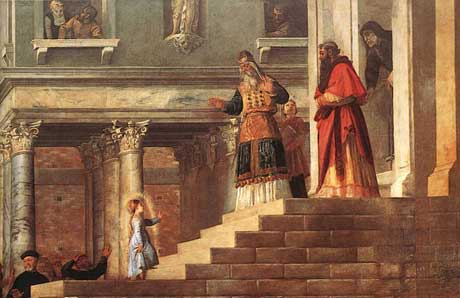
Today, the 21st of November, is the Feast of Theotokos Entering the Temple.  I think this is a story little know outside of the Old Church; it's not clear to me that Catholics or Protestants have much legend about Mary before Jesus is born.  It casts Mary as a powerful priestess in her own right, and highlights Jesus's role as an inheritor of the line of Sarai, not just the line of Abraham.

Like me, Mary was a "miracle baby".  Her mother, Anna, and father, Joachim, had long attempted to have children, but Anna's body betrayed her, and she could not bring a child to term.  She prayed, and conceived Mary, and bore her.  In the fall of her third year,  Mary was taken to the Holy Temple in Jerusalem, where her great uncle (Anna's mother's brother) was the high priest.  There, she was almost immediately recognized as special; the Presence hung on her and she shone.  She studied there for 9 years, until she came of age.

Sarai, too, in my personal mythology, was entered into the Temple as a young girl.  I dreamt once, of going to the Great Temple, to tell my great uncle of a powerful dream, and to demand the blessing that assured my entry into the mysteries.

There is a small chapel on the summit of the hill of Eleusis.  It opens only for the Festival of the Entry of the Most Holy Theotokos Entering the Temple on Novemeber 21st.  One day, I very much wish to be there for this festival.