Wednesday, May 30, 2018

The Orphic Hymn to Okeanos


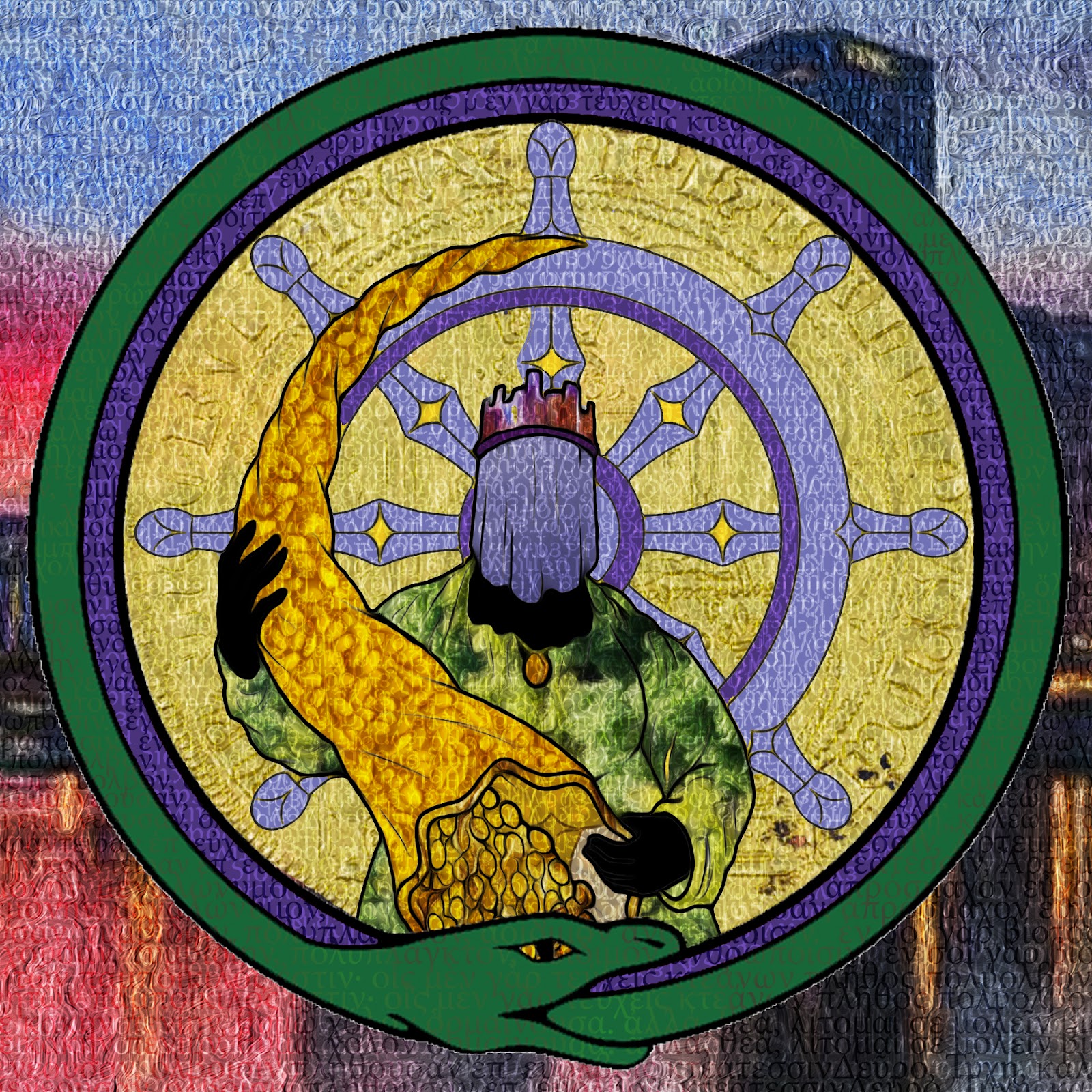
original Okeanos ikon by Sara Mastros & Brian "Chase" Charles


The Orphic Hymn to Okeanos


Imperishable ocean, to you we now call,
Eternal Okeanos, undying Father of All.
Gods and humans both arise from your infinite flow
and all things above begin deep below.
You encircle the earth with great heavings surges
Eternal blue depths where every river converges,
Wellspring of water nymphs, source of the sea,
Birth waters of the Earth, awesome and holy,
Hear us, blessed one, sumptuous divine purifier,
and rain down on our planet all we require.
Your  watershed reaches the ends of the earth,
Your encircling boundary is death and rebirth,
Great Father Ocean, grant your initiates plea:
Gift your favor forever, as vast as your sea. If you enjoyed this translation, please consider pre-ordering my new book,
The Orphic Hymns Grimoire at www.OrphicHymns.com You can read more about Okeanos here:
https://drive.google.com/file/d/1mtMjhOAtJWsxoA0bnbVtIeuJ2vJq2vM1

Monday, May 21, 2018

The Orphic Hymns Grimoire

Tomorrow at 9:39 am (because astrology) the Kickstarter for my Orphic Hymns Grimoire goes live.  Since I'm a big believer in "try it before you buy it", I've included a sample chapter (the one on Tyche, the goddess of luck and fortune) below. Click here or on the ikon to read it. Please enjoy it, and check out the project at www.OrphicHymns.com

Tyche
The Goddess of Fortune

Come, Tyche!  
We call you, Enodia supreme,
Sovereign of crossroads, altogether good Queen.
Song-renowned daughter of Euboleus’ bloodline:
the good guide who fell, along with his swine,
through the cavernous crack in the crust of the earth,
when Kore descended at Persephone's birth.
Tyche, we call in the great name of Artemis!
Gentle essence of fortune, wondrous and marvelous,
Your irresistible wish is our sovereign command,
For yours is the increase of riches and the wealth of the land.
Sorcerous and streetwise, you weave the tapestry of fate,
with stitches of riches, for those you appreciate.
But those who anger you, you sew into poverty,
Spinning their minds into tangles of anxiety.
Sweet goddess, Eutykhia, be my lifelong companion,
Rain down your favor and your nourishing compassion.
Grant happiness, strong-wishing, and generous charity,

Bless our lives and our work with unending prosperity.


https://drive.google.com/file/d/1I-Ec254Lk1Z5zmeaubxzMTMkxpwRq7uq/view?usp=sharing


Saturday, May 5, 2018

The Lyres of Ur

As most of you know, I've been working on retranslating the Orphic Hymns.  The Hymns are a collection of invocational orations, written in Turkey, likely in the 3rd century CE.  Unquestionably, they represent a much older tradition. The 1962 discovery of the Derveni papyrus, from the 5th century BCE, contains commentary on material similar to the Orphic hymns, and treats it as already old.

The magical current we call Orphism undoubtedly entered the Greek speaking world from the East.  The hymns contain the names of several Anatolian deities who were otherwise unknown in classical Greece, including some which were completely unknown save from the hymns until being rediscovered in inscriptions in Anatolian tombs.  Personally, I believe the current to be extremely old, undoubtedly predating writing.

When I imagine the archetypal Orphic lyre, I am always
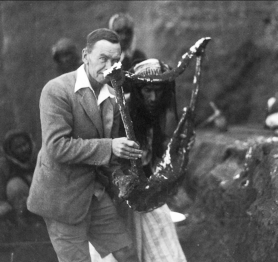
imagining the fabulous Lyres of Ur (modern Iraq).  In the late 1920s, a team funded by the British Museum and the University of Pennsylvania excavated the royal tombs at Ur.  Among the many treasures they discovered were three mid-sized lyres and one large harp, all of similar design.  The reconstructed one pictured at the left is held in the British museum, along with another one of similar size coated in silver (called "the queen's lyre).   A plaster mold taken by the archaeologists at the time of it's discovery is pictured above, to give you some idea of the scale of it. The finest of the three lyres, covered in gold, and was held by the National Museum of Iraq until it was stolen or destroyed in 2003.  The final lyre, which is much larger, went to the Penn Museum in Philadelphia, where I first encountered it at the age about 12.

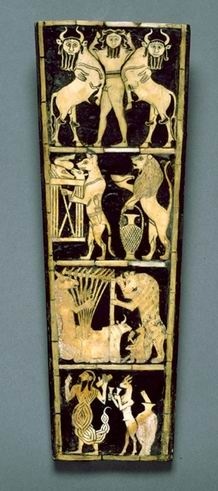
The Great Lyre, called also The King's Lyre, pictured at left, is very similar to the one pictured above, although somewhat larger.  You can see an entire gallery of images from all angles, including some showing restoration in progress, here.   I was overawed when I saw the Great Lyre; his form burned into my mind.  The great golden bull of heaven is often identified as Shamash, the sun god, Below the bull's head, a series of panel illustrations depict fantastical scenes.  You can see them, with the head removed for greater clarity, on the right. 

The first panel depicts the Lord of Beasts, wrestling with two animals.  This is sometimes said to depict the control of nature exercised by the state.  In the next scene, a hyena carries a tray of butchered meat, while a lion holds a large jar and a pitcher similar to some found in the tombs.  (the dagger the hyena is wearing was also found) . In the next panel, a horse plays a lyre while a bear holds it steady.  At the bear's feet, a small animal is playing a rattle.  Finally, in the bottom panel, a deceased spirit meets the scorpion-man, guardian of the entrance of the underworld.

HERE you can listen to a replica of the lost golden lyre, accompanying a recitation of the Epic of Gilgamesh.


Wednesday, April 4, 2018

Adonis has two mommies

Yesterday, in a sorcery group, I mentioned the myth of Adonis, and was surprised how many didn't know it.  It's true, like many other stories that conflict with the dominant patriarchal theme, this one was largely sidelined my the more mainstream Olympian oligarchy.  Short of being slang for a very attractive man, we've lost the story of Adonis, of the abused boy, almost entirely.  I'll tell the story, and then I'll talk some more about it.  The version below is largely based on Ovid's telling, although I have woven in others' takes, particularly that of Sappho, as well, in an attempt to tell the story for modern listeners.

On Cyprus, the island of Aphrodite, King Cinyras had sex with his daughter, the blameless virgin Myrrha, and then blamed her for seducing him. This is a story as old as time, and one doubtless playing out in your neighborhood right now. Aphrodite looked kind on the girl, and transformed her into a tree, so that she could not be further abused.  The tree, called myrrh, cries even today, and her tears smell of longing, and grief, and magic.  Myrrha gave birth to beautiful boy, who screamed and caterwauled beneath his tree-mother.  The boy was the most beautiful thing Aphrodite had ever seen, and she picked the boy up, and dandled him, and nursed him at her own breast.  But then, she grew bored of him.  Aphrodite isn't the mothering sort, and so she gave the boy to her cousin, Persephone, to raise below the world.  There, in the silent darkness beneath the world, the boy thrived, growing more and more beautiful every day.  When he was full grown, he was, undoubtedly, the most beautiful human the world had ever seen.  With Persephone's blessing, he walked up out of Hell and into the living world, where Aphrodite saw him again, and she desired him.  Persephone, his mother, did not approve of this mating.  Aphrodite had, after all, turned his mother into a tree, rather than just smiting her rapacious father!  Aphrodite, had, after all, nursed this boy at her own breast!  It just wasn't right.  That was Persephone's stand.  Just not natural.  And also, it wasn't fair.  For Persephone also lusted after the boy, although she would never admit that, or act on it.  The laws of the underworld are strange, we are told, but all-together just.

The sides were drawn up, with the Queen of Life on one side and the Queen of Death on the other.  The world was coming apart at the seams.  Father Zeus intervened, and a compromised was reached.  In the dry season of death, Adonis would be with his mother, Persephone, below the world, among the shades, deathless and immortal, and there he would continue to learn at her side.  In the hot season, the wet season, Adonis would be with Aphrodite, as her human lover.  And the last third of the year, he might spend as will.  The two Queens agreed to this bargain, and then they told Adonis his fate.  Some say that he chose to spend that third with Aphrodite, and some that he spent it wandering the world.  In any case, years passed, with Adonis commuting back and forth from his mother, the Queen of Hell, to his lover, the Great Green Goddess.  And then, one day, the young man went hunting with his companions, who slew a sow, the sacred animal of Persephone.  Adonis gaped in horror, and still was gaping in shock when the wild boar's tusks entered into his belly, and he dropped, bleeding, to the forest floor.  The laws of the underworld are strange, we are told, but all-together just.

Aphrodite, on Cyprus, cried out in pain.  Adonis is dead!  Adonis is dead!  And she taught all the women to weep for him.  Adonis died that the plants might live, it is said.  Adonis's blood waters the fields.

-----------------------------------
The myth of Adonis, and the cult surrounding it, was almost undoubtedly of eastern origin.  Adonis is the Greco-fication of the Hebrew title Adon, meaning "lord", and nearly all modern scholars are in agreement that this is a Greek retelling inspired by the much older myth of Ereshkigal (Persephone), Ishtar (Aphrodite), and Dmuzi (Adonis).  There is no question that, as a deity, the figure of Adonis is intimately linked, both etymologically and magically, to the Phrygian Attis, the Semitic Tammuz or Baal Hadad, and the Egypian Osiris.

"Attis, beloved of Cybele the Queen.  Attis, the fruit and the grain.
Attis the Christ who could have been.  
Attis the lover of Life.
Julian calls you the Substance of Mind which draws forth Creation to Being.  
You push up the plants from below the black earth, you bring down the light from the stars.
Attis, beloved, the lover of Life, enliven, enlighten, inspire.  
Open to me the seal of the church, make open our way through the hills.
Open within us the seal of the church, make open our way through the hill.
We come in the name of the Mother of All, from the cave in the deep of Her womb.  
We come from the cave at the heart of the Mountain, miles north of the Meander’s mouth.
We come from plains where Artemis reigns, from the city of Sardis last week.
We come from Philadelphia, the city of family love.
Our ancestors stand behind us, descendants we are of the gods.  
The horseman, the king, the duke of our war stands ready to press our case.
Attis, Adonis, the lover of Life, make open the way through the hill." From the fourth gate of Apokalypsis, a game of initiation. The fourth gate is the last public gate.

Monday, April 2, 2018

The Orphic Hymns

I've been working extensively with the Orphic hymns lately, and retranslating/arranging some of them.  In English, there are really only two trnaslations of any value that I've found.  The first are Thomas Taylor's 1792 translations, which are in lovely verse, and time-tested in ritual, and the second are by Apostolos N. Athanassakis and Benjamin M. Wolkow, which are literal, but not very lyrical.  I've been trying to bridge that divide.  I take some liberties from the original, but try to hew closer than Taylor, but I'm still keeping them in verse.  I've put several below; these are still rough, so they will likely change some.

#7: To Eros Protogonos
O Eros Protogonos , we ask you heed our prayer! 
Twofold, Egg-born, and Wandering through the air;
The roarer who glories is fine golden wings,
from whom the race of mortals springs.
Erikapaios, you celebrated power,
ineffable, occult, all-shining flower.
From your darksome swirling mists to the purest sight
All-spreading splendour, pure and holy light,
Hence, Phanes, called the glory of the Sky,
On wavering pinions through the world you fly.
Priapus, dark-eyed splendour, to you we sing,
Genial, all-prudent, ever blessed king:
Look with joyful aspect upon these rites divine,
And give your holy consecration and your all-propitious shine.


#10: For Selene
Hear us, holy Goddess, Night-shining Queen,
Light-bringer, Radiant One, splendid Selene:
Cow-horned moon, racing through the night,
Nocturnal, torch-bearing, maiden of light,
Waxing, waning, male and female combined,
Luminous silver-rayed Mother of Time,
Whose warm glowing orb illumines the Night,
All-seeing, vigilant, beautiful, bright,
Mother of ages, fruit-bearing Moon,
Whose warm glowing orb reflects the light of high noon
The rich quiet black is your eternal delight,
You grant favor and and luck, shining jewel of the night,
Marshal of stars, purple cloaked, silver veiled,
Queen of the Night, Aktiophis, we hail!
Shine on our rites with your all-blessing rays,
O maiden, accept your initiates’ praise.

#56: For Aphrodite
Ourania, beloved, laughter-loving Aphrodite,
Sea-born, birth giver, night festival queen,
Crafty mother of needs, you make mortals to mate,
Fruitful mother of the world, you cause the Kosmos to procreate.
You are the sovereign of the three worlds and the origin of everything,
The Heavens, the Earth, the Ocean: from you they spring.
Holy companion of beloved Bacchus,
You delight in festivity, mother of Erontes,
Seductive Beauty, who loves to make love
Joy-giver, Secret Aristocrat and Hidden Dove,
Romantic companion at the table of the gods,
You are love’s true sire, bearing reel and rods,
You give us our children, our loves, and all loving actions,
Desirable one, life-giver, you couple up mortals in unbridled passion.
Every wild beast is frenzied in your arms,
Heavenly daughter of Cypress, lend us your charms,
We behold you, royal Goddess, splendid of countenance,
On your Syrian throne, redolent of frankincense,
Or riding the plains in your iridescent chariot,
Flanked by your priests in the bathtubs of Egypt
Riding swan-driven carriage upon the waves of the Sea,
Delighting sea-creatures as they dance in your breeze.
You bring joy to the Nymphs of the Earth and the Forest,
And those who leap lightly to the song of your sea-foamy chorus.
When seated in Cyprus, oh Queen Most Divine,
where your blessings are spoken by maidens most fine.
They sing for you, blessed one, and immortal Adonis,
He the grain god, and you the Green Goddess.
We summon you now with fine words and pure souls,
Hear our words, drink our wine, and smoke of our bowls!

#63: For Justice
Oh, Holy Justice, blessed and beloved one,
You take pleasure in all that is rightly done,
You are honored by all, blissful and bold,
Lofty, right-thinking, you cannot be sold,
Nor bought, for you are inviolate and incorruptible,
You break even those who think themselves untouchable,
Who in their greed attempt to cheat your great scales,
Unbalancing what is right, attempting to grease the rails.
But you are dauntless and all-charming, beloved of all,
For you rejoice in peace, and a life that is stable.
You loath the unfair and delight in what’s right,
You are the crown of the virtues and wisdom’s true light.
Shatter the wicked, mighty Goddess, we pray,
So that all who nurse from the breast of the Earth,
who from the depths of sea were first given birth,
May follow your path of justice and nobility,
Living in harmony and peaceful tranquility.

#80, To Themis:
I call lovely Themis, daughter of Earth and the Sky, Who first spoke as oracle in the recesseses of Delphi, On Pythian ground, above the bubbling spring, You taught the young Phoibos to be a just king, You are honored by all, bringing justice’s light, For you first taught to humans worship’s delight, You howled first to Dionysus with infinite glories, You teach us the mysteries and you tell us the stories, Come, blessed maiden, attend our mystic rites, And rain down your favor upon us, your acolytes.

Thursday, March 22, 2018

Incantation Bowls

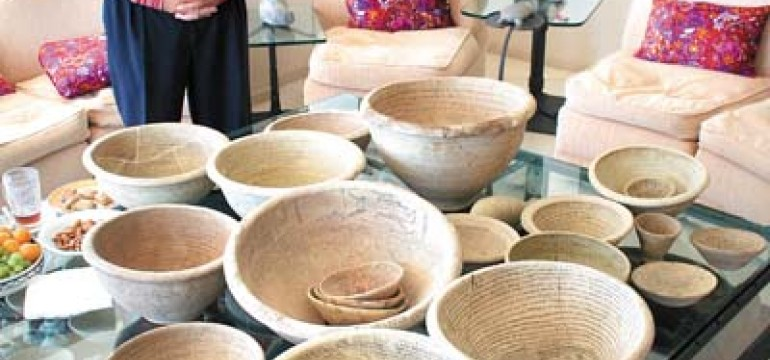
This past weekend, I was at the Sacred Space convention in Hunt Valley, MD.  It's my favorite witching conference, and I came home all abuzz with new ideas.  Among the many wonderful classes I saw, I also taught a class on Babylonian-style incantation bowls, a type of home protection charm which appear to have originated, likely among Jewish communities, in the Near East in late antiquity. Approximately two thousand such bowls have been discovered, primarily in Iran and Iraq, dating from the 2nd to 8th centuries CE.  Most often, from the outside, the vessels appear to be plain clay bowls. Inside, the bowls contain an incantation (usually in Aramaic), usually written so it spirals in from the rim to the center of the bowl.  In addition to the words, there are often illustrations of demons in chains. Some bowls, instead of writing, have squiggles and waves, thought to be used by illiterate magicians to imitate writing. Almost every bowl has a purpose-specific incantation; they were likely individually composed by the magician making the bowl for the particular circumstances it was to be used in.  However, many bowls contain familiar symbols (like the snake who swallows his own tail, called ouroboros) or magical names, such as those found in the famed Greek Magical Papyri.


There was a large Jewish community in Nippur (in modern day Iraq) in the 3rd century. This community was especially fond of these demon bowls. Nearly every house excavated has contained at least one.  They are all very similar, likely made by the same magician, and often contain passages from the Torah, usually Psalm 104:20; Exodus 15:3; Psalm 24:8; Psalm 10:16; and Exodus 15:18.

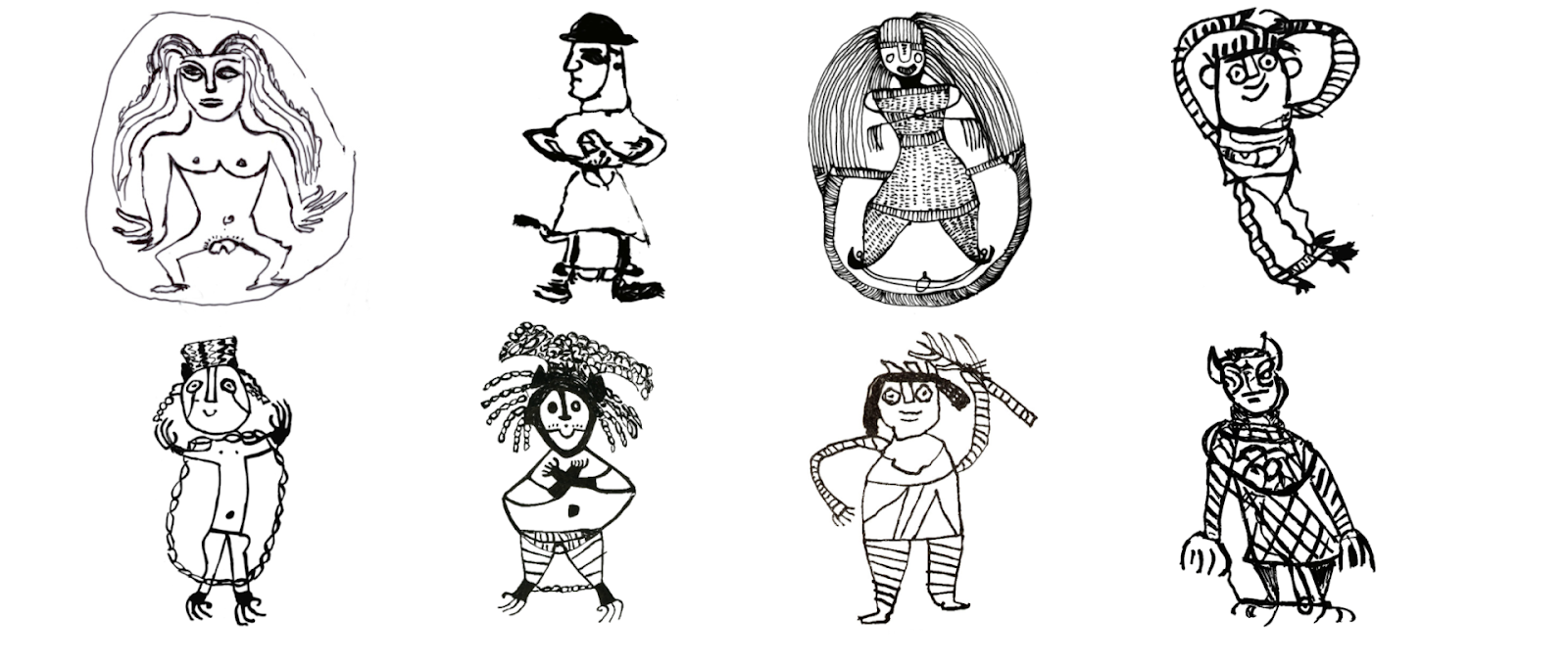
some demon illustrations from various bowls


The bowls are usually found buried upside down, most often in the corners of rooms, thought to be a place where demons could sneak into a home through the crack between wall and floor. Occasionally, two bowls are found glued together to make a hollow ball. In these cases, there are often items inside; eggs are particularly common in this case. There are, broadly, four types of incantation bowls:

  1. The most common type are house protection and general anti-curse talismans.
  2. Another common type are intended to protect specific people from particular curses.
  3. Sometimes, they are intended to cure people of specific afflictions, such as migraines.
  4. The final kind have “pseudo-script” and were likely created by illiterate people for their own use.  
    1. One imagines these have the same spread of uses as the literate ones

The text on the bowls is pretty formulaic.  Most include some, but not all of the following:

  1. An introductory formula giving them name of the magician and their magical titles or pedigree, etc.
  2. Brief quotes from Torah.
  3. A description of the function of the bowl.
  4. A “divorce decree” of exorcism formula, casting out  / divorcing demons and Lilith(s).
  5. A restraining order against demons and etc.
  6. Voces Magicae and “Barbarous” Names
  7. A concluding formula. (such as “amen, amen, selah” or etc)
  8. An illustration of a demon in chains. (or occasionally other things, shapes, etc)

DIY DEMON BOWLS
Bowls such as these can be easily made from wooden salad bowls, which I frequently find at thrift stores for less than $2 each.  They can also be made with ceramic bowls, or even papier mâche bowls. Personally, I like wooden bowls best, because the porous nature of the wood allows you to incorporate magical oils into the enchantment.  No matter what sort of bowl you use, a Sharpie-style permanent magic marker is the best choice for adding the inscription. If you’re using a wooden bowl, you’ll also need a variety of grades of sandpaper. You’ll also want some paper and a pen, for planning your inscription.  The first step is to decide what your bowl should say. You’ll most likely want to include your own name, the name of your home, and then to call on your personal gods and spirit allies to protect you. You may also choose to include an illustration of a demon in the middle of the bowl, and any magical symbols you like.  Practice writing out the inscription several times to make sure it will fit properly inside the bowl. When you’ve settled on an incantation, it’s time to prepare the bowl itself. You need to awaken the bowl as a magical object. Speak to it, pet it, treat it with love, as a living thing. If you are using a wooden bowl, sand it to a super smooth finish, loving and speaking to it the whole time.  Rinse off any sawdust, and prepare yourself to write the incantation. Speak the incantation aloud as you write it. If you choose to write in a spiral, it should spiral in from the rim. When you're done writing, let the ink dry for a bit, and then wax the outside of the bowl with the wood blessing wax below. Let it sit for a day or two, and then wipe off any excess wax.

Wood Blessing Wax
melted beeswax (4 oz)
lemon oil furniture polish (I use this brand)
Magical oils appropriate to the task (for this, I use dragonfire protection oil)

Slowly mix the oil into the wax until a thick paste is formed.  Mix in the magical oil. Apply with fingers or paper towel. Let sit for a few days, then wipe off excess.   Emergency/Temporary Bowls

These are especially good for hotel rooms, which I find to often by psychically/spiritually "crudded up".

You will need:
2 paper or styrofoam plates.  Paper is better.
an egg (optional)
a sharpie marker
a sterilized needle
a stapler

Take two paper bowls, and draw a demon trap of some kind.  This can be a pentagram or a labyrinth to "trap" the spirit.  Even better, write an incantation spiraling in towards a picture of a demon in chains) on the bottom of each bowl.)

Pray over the bowl, asking that your gods (or G-d, or whatever) trap all evil spirits within the bowl. Take a whole egg, prick your finger and drip one drop of your own blood on the shell (as bait) and put it in one bowl. 

Put the other bowl upside down on top and staple them together. 
Hide the whole thing under your bed or in the closet or something (because that's where monsters live, obviously!).  If the trouble is localized, put it near the epicenter of the disturbances, but somewhere a little out of sight.

After three days (or when you are leaving), take the whole thing outside (DO NOT OPEN IT) and burn, bury, or otherwise dispose of it. If you have been tending a sacred spot, bury it there, and ask the land to neutralize it.

If you can't burn or bury it, put it in a plastic ziplock bag, pour a whole canister of salt in after it, seal the bag closed, and go put it in metal dumpster (ideally one far away from your house)

Tuesday, February 13, 2018

The Symposium

It all began with a discussion among some friends about Plato.  We were talking about our favorite books, and it turned out that we all really loved the Symposium.  (Yes, my friends and I are all dorks.  You know you're jealous!)  And so, by the end of the evening, the invitations went out:

"In the 4th century BC, Plato wrote one of the most influential works of all time: the Symposium. A series of speeches to Eros, god of Erotic Love, this work has shaped, if not directly influences, almost all of what we westerners think about love and romance.
But times are a-changin', and we're no longer in the world of ancient Athenian (oligarchical, patriarchal) aristocrats. Since love is a fixture of the human experience, why not update this work? Moreover, why not update this work *by actually holding a symposium of our own*?
So let's dedicate a night to Modern-day Eros, get boozed up, and hold a symposium of our own? On February 9th, we'll gather at Witch House with good food, the intoxicants of your choice, and a prepared speech, poem, or other presentation on the nature of love as an offering to Eros.  Wear red."


The evening went better (and worse) than I think any of us expected.  It turned out to be an exceptionally powerful, healing, contentious, fun ritual.  I strongly recommend you to try it with your own circle.  Not everyone at the table has to be a magician, but I'd recommend at least 2 solid magician who can maintain the energy and flow.  We had several spontaneous possessions (mostly by Eros himself, but Alcibiades, the drunken student of Socrates and military genius also showed up).

We began with pasta primavera, wine, liquor, brownies, and music while we waited for some late people, who arrived just in time for the hour of Venus.  We made opening invocations and offerings, which you can find below.  The three hymns to the gods are my own adaptations of the Orphic hymns to Protogonos (#5), Aphrodite (#54), and Eros (#57). You may substitute other offerings.
START IN THE HOUR OF VENUS

Open Space/Time in your usual fashion. Aspirgate with basil.

Player One: Light Eros incense (buy that here or make your own)
(myrrh, roses, erontas, cinnamon, honey, and amanita mushrooms)

Player One: Offer Honey & Light Gold Candle

O Eros Protogonos , we ask you heed our prayer!  
Twofold, Egg-born, and Wandering through the air;
The roarer who glories is fine golden wings,
from whom the race of mortals springs.
Erikapaios, you celebrated power,
ineffable, occult, all-shining flower.
From your darksome swirling mists to the purest sight
All-spreading splendour, pure and holy light,
Hence, Phanes, called the glory of the Sky,
On wavering pinions through the world you fly.
Priapus, dark-eyed splendour, to you we sing,
Genial, all-prudent, ever blessed king:
Look with joyful aspect upon these rites divine,
And give your holy consecration and your all-propitious shine!
Player Two: Offer Brownie and Light Green Candle
Ourania, beloved, laughter-loving Aphrodite,
Sea-born, birth giver, night festival queen,
Crafty mother of needs, you make mortals to mate,
Fruitful mother of the world, you cause the Kosmos to procreate.
You are the sovereign of the three worlds and the origin of everything,
The Heavens, the Earth, the Ocean: from you they spring.
Holy companion of beloved Bacchus,
You delight in festivity, mother of Erontes,
Seductive Beauty, who loves to make love
Joy-giver, Secret Aristocrat and Hidden Dove,
Romantic companion at the table of the gods,
You are love’s true sire, bearing reel and rods,
You give us our children, our loves, and all loving actions,
Desirable one, life-giver, you couple up mortals in unbridled passion.
Every wild beast is frenzied in your arms,
Heavenly daughter of Cypress, lend us your charms,
We behold you, royal Goddess, splendid of countenance,
On your Syrian throne, redolent of frankincense,
Or riding the plains in your iridescent chariot,
Flanked by your priests in the bathtubs of Egypt
Riding swan-driven carriage upon the waves of the Sea,
Delighting sea-creatures as they dance in your breeze.
You bring joy to the Nymphs of the Earth and the Forest,
And those who leap lightly to the song of your sea-foamy chorus.
When seated in Cyprus, oh Queen Most Divine,
where your blessings are spoken by maidens most fine.
They sing for you, blessed one, and immortal Adonis,
He the grain god, and you the Green Goddess.
We summon you now with fine words and pure souls,
Hear our words, drink our wine, and smoke of our bowls!

Player Three: Offer Wine and Light Red Candle
I Call now great Cupid, source of sweetest delight,
Holy and pure, and most lovely to our sight;
Darting, and winged, impetuous fearsome desire,
You play with both gods and us mortals like wand'ring fire:
Cautious, and dual-natured, you’re the keeper of keys
Of heaven and earth, of the air, and the seas;
Of all that Demeters fertile realms can contains,
whence the Great Mother Goddess all life sustains,
And all whom dismal Tartarus is doomed to keep,
The chthonic expanse of the wide-sounding, deep;
Your commands, all Nature's various realms must obey,
You alone rule the heart, with universal sway.
Come, blessed power, regard our magical fires,
And help keep away the most maddening desires.

Player Four: Offer Water and Light white candle
We call the great philosopher heros to us, to join us in our Symposium:
Plato, Great Teacher, be with us now! May your Wisdom be a Blessing!
Phaedrus, Beloved of Jupiter, may your Wisdom be a Blessing!
Pausanias, Beloved of Mercury, may your Wisdom be a Blessing!
Eryximachus,  Beloved of the Sun, may your Wisdom be a Blessing!
Aristophanes, Beloved of Venus, may your Wisdom be a Blessing!
Agathon, beloved of the Moon, may your Wisdom be a Blessing!
Socrates, Great Teacher of Teachers, Beloved of Saturn, may your Wisdom be a Blessing!
Alcibiades, Beloved of Mars, may your Wisdom be a Blessing!

Diotima, Great Teacher of Teachers, Beloved of Jupiter, may your Wisdom be a Blessing!
Hypatia, Blessed of Mercury, may your Wisdom be a Blessing!
Medea, Beloved of Sun, may your Wisdom be a Blessing!
Helen, Beloved of Venus, may your Wisdom be a Blessing!
Sappho, Beloved of Saturn, may your Wisdom be a Blessing!
Hypolita, Beloved of Mars, may your Wisdom be a Blessing! Next, we each made our presentations/speeches. Our circle happens to be composed primarily of writers, so there was a lot of poetry, but you could also give speeches, sing songs, preform dances, or whatever feels right. The important thing is for each person to try to evoke their own personal Eros. Mine, an original hymn to Eros Protogonos (Firstborn Eros, or Primordial Eros) is below:
Hymn for Eros Protogonos

Hesiod tells us, as only he can
That long before begetting began,
Long before the birth of the Earth,
In the beginning, “Xaos came first”.

In a sinuous spasm of shuddering, shivering,
Shimmering, jiggling, quickening, quivering,
As a voluptuous void of thick viscous mist,
Howling and moaning, Xaos came to exist.

Xir ragged breath shaking in gasps and in grunts,
Xe ejaculates seed from Xir infinite cunts,
Crystalline crumbs of uncut actuality,
Coalescing, condensing, into our reality.
Great Mother Matter whom Hesiod called,
“wide-bosomed Gaia, firm foundation of all.”

Next, we are told, by our Muse-tutored rhapsode,
“Eros shone forth”, from his cosmic abode,
“The fairest of all of the immortal gods,
Who unnerves the limbs and sets minds all at odds,
Eros shuns reason, refusing wise counsel”,
He makes sinners behave, turns saints into scoundrels.

Eros, Sex-Love, third-born from the Dark,
the gravitational force that draws quark close to quark,
His shuddering orgasm was that very Big Bang,
Mathematical symphony the first angels sang,
He gave passionate atoms their nuclear fire.
Eros, the Lucifer, god of Naked Desire,
Lit the spark of the stars and warmed the cold Night,
Giving heat to the universe, he let there be light.

Then Eros awakened the womb of the Earth,
And out flowed the Sky, the very first birth.
Gaia and Ouranos, united in love,
The Earth’s firm foundation, the Heavens above,
Their waters were joined, the primordial soup,
their commingled essence, that amino-laced goop,
The  roiling ocean from which all life springs,
Eros instigator of the Ten Thousand Things.

Evolution went slowly, in those early days,
Until Eros taught Life His creative ways,
Igniting the yearning for recombination,
Eros taught us the arts of sex and flirtation,
Dividing the genders, as woman and man,
beginning begetting from whence you began.

Now, there are some things you have to be prepared for: First, we made a conscious choice to not invite couples, because we were afraid that their energy would create little mini-circles, and break the cohesiveness of the circle. Second, this perhaps should have been more obvious to us going in, but it turns out almost everyone has a lot of conflicted feelings, and a sizeable amount of anger, at Eros. Everyone is intoxicated, there's a lot of magic going down, and you're working with powerful, passionate, complicated forces that everyone yearns for, but whom everyone has been done wrong by at least once. Some of the speeches/poems were very personal, and some very political. Things got heated. There was yelling and crying and laughing. Someone stomped out. This isn't work to do with strangers. This is work to do with people you can fight with and still love the morning after. This is work for a real circle, done in perfect love and perfect trust.